
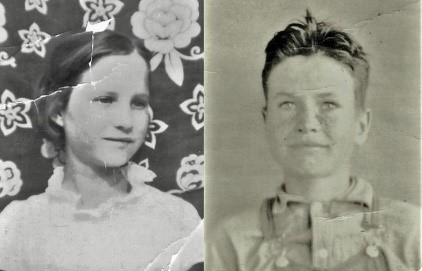
Clifton Tilford Causey was born 20 May 1923, the seventh of seven sons born to John Solomon and Lillie Adeline Mozingo Causey. He met my mom, Edna Lucille Beasley Causey, 1923-2014, in 8th grade. She and other girls were competing for his attention. Mom bragged that she was the winner. They were married on 15 March 1943 not long before dad was drafted into the Army and sent to the Pacific theater with the 1542 Topographic Engineer Company. My Sister Faye was born in June 1944 not long after dad left to serve in WWII. Dad was honorably discharged in February 1946, I was born nine months later.
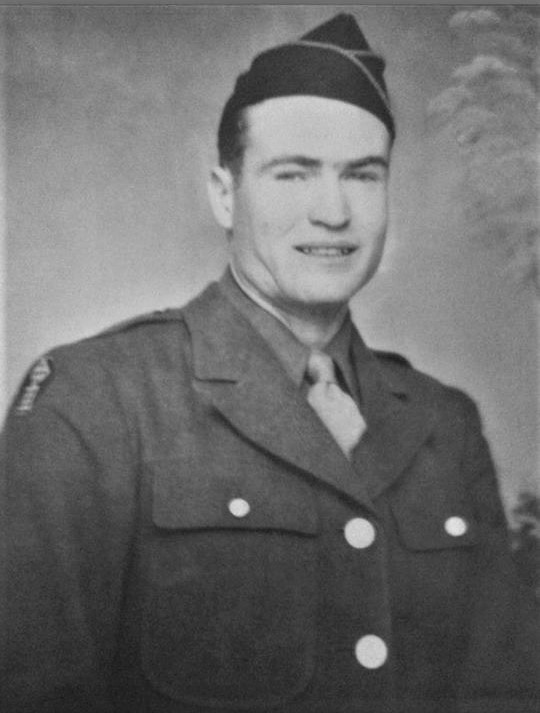
Dad enjoyed his two years four months service during WWII. Much of the following history of his service during World War II comes from his unit history, written by the staff of the 1542 Topographic Engineer Company.
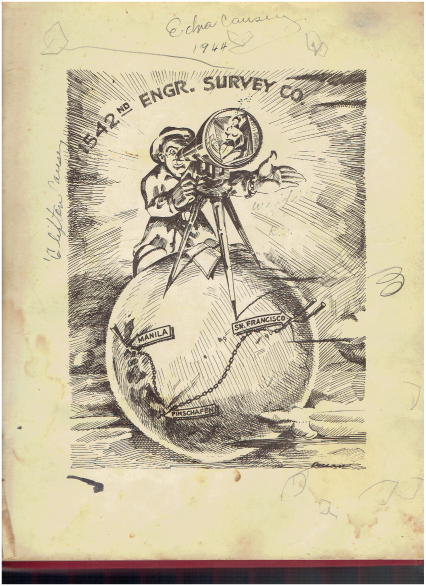
Assigned to a topographic survey company, his served as a vehicle mechanic and truck driver. Relationships born out of two years of daily life together made for strong bonds of friendship. In the last few years before his death in 1963 Dad visited several of his service buddies. Private Clifton Tilford Causey entered active duty 14 October 1943 at Fort McClellan, Alabama. He attended basic training assigned to Company B39, and Motor Vehicle Mechanics School at Fort McPhearson, Georgia. He was then assigned to the newly formed 1542nd Engineer Survey Company. Following is an extract from the unit yearbook: “From various places in the nation and from various branches of service we came to Galesburg, Illinois, rode the branch line to Table Grove and were backed into Camp Ellis. Fortunately we didn’t realize at the time how hard it was going to be for a man without a car to get out again. At the camp we were assigned to training companies which turned out to be reassignment centers. Of course, being in the Army, we went through the regular program of police call and other things equally as important but aside from that we watched the bulletin board for a new assignment. Then when we saw that certain name appear under “The following EM are assigned to” we wondered what a survey company might be and why we were in it what-ever it was. The 1542nd Engineer Survey Company was activated on May 1, 1944. On the day of activation the company roll included Lt. Kenneth Coleman. Mario Boren°. Boyd Howard, Sherman Bartell, and John Halvorson. During May Captain C. E. Drysdale took over as company commander and the company was brought up to strength, while some left on furlough. Among the men who came to the 1542nd there was a wide divergence of feeling. Some who came from combat engineer and anti-tank corps outfits were frankly relieved to be in a less rigorous branch of the service. Others released from the Air Corps, who quickly became known as the “Glamourboy Cadets.” bitterly bemoaned their fate. Others griped loudly out of habit. A relatively small number sensibly felt that one way was as good as another to sweat out the war. From May 1st, six and one half months were to elapse before the company pulled out of Camp Ellis for a destination unknown.”
Meanwhile in the Pacific Theater, General MacArthur’s island hopping campaign was gaining ground against the unyielding Japanese forces. As frontline forces continued to move north from Australia into southern Philippines, the follow-on units were not far behind.
Training was over. Around the 20th of August 1944, Soldiers of the 1542nd Engineer Survey Company, including Tech Sergeant Clifton Tilford Causey, began their short furloughs home to “which should be used in setting home affairs in order before the big push.” According to the unit history, “On Thursday, 16th of November, we made last-minute telephone calls and drank the last bottle of beer at the PX. Friday morning we cleared the barracks and then waited several hours for transportation. When it came, the top kick, Harvey Weber, called the roll, we mounted the cars that were to take us to Pittsburg, California. The 1542nd had completed the first chapter of its history Chapter two was short—eighteen days to be exact. Four of that number were consumed on tracks which took us over the Colorado Rockies and down the Feather River Canyon into California. The future and what we were leaving behind occupied our thoughts. Above the noise of the train there was the sound of rattling bones and shuffling cards. At intervals we stretched our legs by the numbers on station platforms or took off on the double around the block. There were to be many days when we would wish for a breath of that fresh Nevada air. Our accommodations were not deluxe but were comfortable enough. Enroute the news leaked out that we were headed for Camp Stoneman. The skeptics still insisted that the 1542nd would never go overseas—the company would be broken up at the staging area. The outfit was full of 4 F’s, they said, who’d be screened out by the rigorous physical exam. We didn’t have long to speculate. The train chugged its way through California, stopped to let every local freight go by, but finally pulled up at the Stoneman station. The events of the next few days convinced even the skeptics that a rumor had at last become a fact. A broken-down inebriate could have passed the physical. Needles pricked our arms and punctured our sense of security. We were issued additional equipment—combat boots no less. We were lectured on military security and censorship. We climbed up and down landing nets. While we performed KP duty and guard duty we were fattened for the kill. Thanksgiving dinner was something to remember. We drank gallons of those luscious milk shakes. We finally realized that we hadn’t long to partake of the blessings of civilization, so some of us, not mentioning any names of course, took the “Burma Road” into Pittsburg. At the San Francisco Port of Embarkation we lined up again prepared to board ship. Over a gate ahead of us we read: THE BEST SOLDIERS IN THE WORLD PASS THROUGH HERE, and we swelled with pride until they led us through the other gate. The sensation experienced in struggling up that gangplank under helmet, carbine, cartridge belt, gas mask, and duffle bag is an individual matter. We shan’t attempt to describe it.”
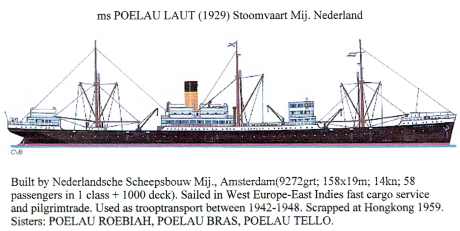
Dad found himself aboard the Poelau Laut, a Netherlands flagged cargo ship built in 1929 now converted to a troop transport. When we think of San Francisco Bay we envision the Golden Gate bridge and maybe Alcatraz. The young soldiers loading on to this ship had other things on their mind. Again, from the unit history, “Guards were stationed on board to ward off any possible consequences of gang-plank fever. The martial music the band played sounded like “Blues in the Night.” About six o’clock we passed under the Golden Gate and out into the bay where we dropped the pilot. It was the 29th of November, 1944. The ground swells kicked the boat about considerably and our unseaworthy legs began to buckle. Chapter three opened with most of us at the rail or in the “head.” Chapter three brings to mind Poelau Lout, “Now hear this,” flying fish, “Eager Beaver,” Neptunus Rex, pinochle and set-back, and our heavy-weight champ. We remember also the sticky heat of the hold and the galley, and the scramble for deck-space when we were dismissed from the evening stand-to. Hammocks appeared in the rigging and a ludicrous pen-house was erected at the mast. She was a Dutch ship officered by a jovial Dutchmen. The Skipper and his crew and Chaplain Decker and his helpers in charge of recreation made life on board as pleasant as was humanly possible. Probably most of us have as a souvenir a copy of Now Hear This with its cartoon by “Yuke.” The loud-speaker system brought us a classical hour and a jive hour. There were boxing tournaments in which the honor of the 1542nd was nobly upheld. The scapegoats of the Neptunus Rex party paid dearly for the fun the rest of us had as we crossed the equator. Well-attended church services were held regularly. As much as we griped about lugging those life jackets around we all realized they might come in handy. When we gazed over the side at the evening stand-to and realized that enemy submarines like to take advantage of the proper light to do their dirty work and as we listened to Chaplain Decker make his remarks for the evening devotion period, even the most unresponsive among us couldn’t help but drift into a contemplative and nostalgic mood as the crew members were instructed to take their places for the Evening General Quarters. Too bad the mood had to be broken when the crowd surged back from the rail to avoid the consequences of the guttural command: “Doonif da Gar-r-r-page,” (Dumping the Garbage). So, my father and hundreds of others not only in the 1542nd but replacements for the wounded and less fortunate who were on their way home were about to disembark.
As the saga of Tech Sergeant Clifton Tilford Causey and the 1542nd Engineer Survey Company, U.S. Army Pacific, continues, our heroes have crossed the equator and the international date-line and according to unit history, “On December 21st we passed through the beautiful China Straits and had our first glimpse of Guinea land at Milne Bay. Milne Bay was only a stop-over for water and fuel. The ship was under quarantine for mumps and we were sweating out a possible new outbreak of the epidemic. Temporarily we lost Lt. Pollaro with an ear infection and Gordon Greene with the mumps. On the 23rd the Poelau Laut pulled out of the Bay and made its way to Finschhafen where on December 24th at about 2:00 o’clock in the afternoon we docked at the pier. Chapter (five) was ushered in under a blazing New Guinea sun as the 1542nd, soaked in sweat, staggered down the gang-plank to waiting trucks. We thought the trucks must he going back to Milne Bay before they finally stopped along the beach and we took over an area cluttered with the debris of war and of a former camp. By the time we had traveled the twenty-mile stretch to the area we already had some impressions. Supplies were stacked all the way along the highway, and at the airport there was an impressive array of planes. It looked as if there might actually be a war on. That first night we made ourselves uncomfortable in pup-tents, ate “C” rations and dreamed of home. What a way to spend Christmas Eve! On Christmas we were no better off for living conditions. Fortunately we were able to eat with the 874th Aviation Engineers and thus had the benefit of a Christmas dinner.” With this dis-embarkment my dad entered the official combat zone.
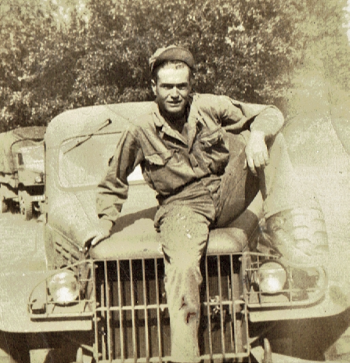
Motor Pool – New Guinea WWII 1945
The stay in relative safety of New Guinea was short lived and it didn’t take long for my dad Sergeant Causey, Motor Sergeant, and the 1542nd to get orders. Unit history records, “The company was alerted for movement on January 2nd, was taken off the alert later and then re-alerted in February. The new alert looked like the real thing. We faced the future with conflicting emotions. We were anxious to do some really worthwhile work, but the possibility of entering the region of air raids and artillery action made us a little reluctant to leave the peaceful New Guinea Scene. Nevertheless, what one does in the Army is not a matter of choice. We packed again and were ready to move out on February 16th, the afternoon of which we spent in waiting for orders to board the boat. At mid-night the 1549th Platoon served us coffee and sandwiches. Then we mounted trucks and rode to the pier where, lined up waiting for the order to board, we could dimly see the name Charles P. Steinmetz, on what was to be our home for a while.
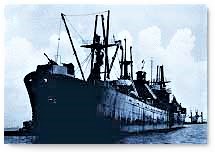
The unit history continues, “The Mindoro Strait brought us to the South China Sea. On the night of February 28th we passed Manila Bay and sailed along the west coast of Luzon, entering Lingayen Gulf early on the morning of March 1st. By noon the Steinmetz was anchored off shore and shortly after we had broken open a few choice rations, we dumped duffle bags over the side and scrambled down landing nets into landing craft to be dumped on the sands of Luzon where we were welcomed by a greeting to become only too familiar: “Veectoree, Joe! Cigarette, Joe?” Evidently the Filipinos had discovered even before we got there that the word “sucker” most aptly described the “Americano.” In late afternoon we began to be impatient about “chow,” but the trucks didn’t arrive until about dark to take us several miles south to a rice field which was to be our area. About 2030 we were served hot coffee and sandwiches. On March 2nd the area was cleaned up and pup-tents erected. After five days we began to unload the company equipment from the boat. In the meantime Captain Drysdale and Lieutenant Adler drove to Manila to pick up orders and to select a camp area. During the nine days we spent at our first camp site we got our first impressions of Luzon and its people. Several towns such as Santa Barbara, two or three miles to the south, and Dagupen were within walking or hitch-hiking distance. We visited homes of hospitable Filipinos where we sat on the floor and ate roast chicken and rice cakes. These provincial people were very friendly to GI’s and heartily detested the (Japanese). They were badly in need of clothes, preferred undershirts to pesos.” My father loved the Pilipino people. They were brave but caring and always wanting to help as much as they could.
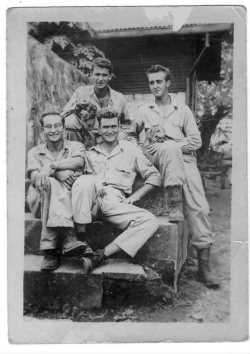
“On March 9 the company packed the equipment on trucks and by nightfall was ready to move out to Manila. Traffic to Manila was heavy and roads were in poor shape so night was chosen as the best time to travel. By dawn of the 10th of March we had bumped our way into Manila where we parked for a delicious K-ration breakfast and then were directed to the area which was to be the base camp for many months. At first sight the area looked anything but attractive. A few hours of cleaning the rubbish… however, revealed a camp site of promise. Situated on Santol St. near Quezon Institute, the Tuascon estate, now a little run down at the heel, was evidently a place of beauty in peacetime. The trees and flowering shrubs weren’t all dead yet. The area was surrounded by a high wall which permitted a privacy seldom the privilege of a soldier. As showers and electricity were installed and the area set in order it became evident that the 1542nd was going to have as pleasant a place to stay as was possible. Manila itself was in shambles. Debris cluttered the streets to such an extent that in many places traffic could move only in one direction. … We didn’t have to wait long for a job. On the 12th two jobs were started: topo of the Quezon area and vertical control of the Manila area. From then on there was no let-up on projects ahead. As this is being written the company has already started on its 45th project. To tell about them all would make this a lengthy and weari-some story. Mention of them brings to mind: rice paddies with knee-deep mud and water; carabao wallowing in the slime; bamboo thickets that fought back with sharp barbs when attacked with a machete; flocks of Filipino progeny making the “V” sign, cute but a nuisance; … sunken ships in the harbor; women washing clothes along the banks of the Pasig. Considering the possibilities, the 1542nd was very fortunate in that no casualties were suffered in the field.”
I am thankful that the 1542nd suffered no casualties. Sadly, during the weeks during their time in Manila, my father had a small lesion on his lower lip. Only 10 years after returning from the war Dad was diagnosed with melanoma radiating from that lesion. But, let’s finish the WWII story before we move his short civilian career. From the unit history we continue, “Months brought little change. The rainy season which always started next month never quite arrived. The base camp remained in Manila. Detached service jobs furnished variety but scarcely ever better living conditions. Although they affected individual members little there were changes in company assignment and attachment. In New Guinea we had been attached to the 6th Army. Upon arriving in the Philippines we were assigned to USASOS (United States Army Service of Supply), ENCOM (Engineers Construction Command) and were attached to LUZED (Luzon Engineer District). USASOS was later absorbed in AFWESPAC (Armed Forces Western Pacific). On 10 October (1945) the company was relieved of assignment to ENCOM and assigned to GENED (General Engineer District). On November 15 our assignment was changed from GENED to Base X and at the same time we were attached to the 29th Engineer Base Topo Battalion. Effective on the same date the 1542nd Engineer Survey Company was redesignated the 1542nd Engineer Base Survey Company. This involved a reorganization to an authorized strength of six officers and two hudred ten enlisted men. At this writing the company status is this: under the operational command of GHQ, AFPAC (Armed Forces Pacific), it is assigned to AFWESPAC and further assigned to Base X, under which it is attached to the 29th Engineer Base Topo Battalion. Changes in personnel, beginning in June and July took effect. Our first loss by the point system was Edwir Nedrow who left the company on June 11, was followed by Harvey Weber, whose duties were assumed by Lee Bussen. Captain Drysdale transferred to the 874th Engineer Aviation Battalion on July 5th and Captain (then Lieutenant) Pollaro took command. Lt. Anderson’s present command of the company was assumed on November 24. On Luzon the company finally hit its stride. Jobs were performed in an increasingly satisfactory manner and organizational wrinkles were smoothed out. Performance in the field and in the computing room met the highest standards. Efficiency was rewarded. The commendation expressed in letters appended to this history came as a result of work of Eddie Brand’s party, but the entire company rightly accepted the praise as indicative of the work being done on every job. As climax to the months of hard work well done, the Meritorious Service Unit Plaque, by command of General Styer, was awarded the 1542nd “for superior performance of duty, achievement and maintenance of a high standard of discipline and outstanding devotion to duty: from 9 March 1945 to 17 September 1945.”
The war was wrapping up. “The end of World War II in Asia occurred on 14 and 15 August 1945, when armed forces of the Empire of Japan surrendered to the forces of the Allies. The surrender came over three months after the surrender of the Axis forces in Europe and brought an end to World War II.” (Wikipedia). From August until the trip home the 1542nd was a peacetime operation. Soldiers, Sailors, Marines, Coastguard, Airmen, Waves, WACs, and Merchant Marines of World War II, including my father and several of my uncles, are my heroes and truly the GREAT GENERATION. I have no doubt that Almighty God guided the efforts and decisions of men to bring about a great but temporary pushing back of the darkness in our world. Here are the final words from the staff of the 1542nd staff, “To every selectee who waits long enough comes that white paper. Seeing the seasons through from Illinois to Luzon has been an adventure filled with experience that only army life can provide. It has been far from the life we would have chosen had we been at home, but all of us realize that it could have been much worse. We have made the best of the situation as we found it and are proud of the job we have done. As we regretfully say good-bye to old friends, we wish them the best of luck and look forward to seeing them again under pleasanter circumstances.”
My father, Clifton Tilford Causey, arrived home from duty in the Pacific Theater during World War II on the 18th of February 1946. I was born nine months later to the day, 18 November 1946. My sister Linda Faye Causey Kimbrell was born two years earlier in June 1944. Our baby brother Ronald Lee Causey came along in June, 1952. That was the Causey family in the early 1950s. Dad came home from the war and for a time received GI Bill training in Winfield, Alabama. He then returned to work in the coal mines. Equipped with additional training learned while in the Army and the GI Bill, he ran the “cutting machine”. At the deepest part of the mine a large machine somewhat like a giant chainsaw spewed out coal from the veins sandwiched between layers of rock. Coal and rock dust thicker than a haboob was breathed by miners all day especially the miner running the machine. Few miners made it to old age. In fact, many if not most died during their thirties and forties. Mining remains hard and dangerous work even today. In 1950 it was a job that doomed the workers to an early grave.
Dad worked in the coal mines of northwest Alabama, a deadly place to work in those days. The memories of my father and mother are absolutely wonderful. Dad was a quiet man always wearing a mild and gentle smile. He loved the pool hall and Friday night movies. Mom made sure he suffered a little on his nights out. I was his escort. He would set me in the middle of the neighboring pool table while he engaged the local sharks. The movies were an education for me. We both loved the color cartoons, the serials that never ended, and movies from cowboys like Randolph Scott to horror films like the Wax Museum.
Dad was a genius. He made sure I helped in all his projects from dynamiting tree stumps, repairing the often broken vehicles, to putting in our first water and sewage disposal in our home. My first vehicle was a project between us. He purchased two old 1954 model Hudson Jets. Through cannibalization and American ingenuity I received my first operational car. There was so much love in our family. Still precious is the picture in my mind of when dad had replaced the old wood-burning kitchen stove with a new electric range. When he plugged it up and turned it on, mom grabbed him and gave him the biggest and longest kiss I had ever witnessed. Dad did his best to provide for us. But, looking back we were dirt poor. I didn’t know it at the time though. We had such a loving family. Every day was special. When working in the coal mine Dad was off to work by 5:00am. Mom was up well before then cooking biscuits and meat of some kind if we had any. Dad loved butter and sugar biscuits. Mom made sure he had four or five biscuits in his lunch pail. He came home black with coal dust head to toe. (And, if there were any of those sugar butter biscuits left, they were mine.) Working the machine meant being splattered with oil which made the coal dust paint a darker black. Dad had a big old well bucket he kept in the barn and a special corner he set up for his shower stall. As soon as he got home he headed out to the barn for a cold shower… fall, winter and spring. Many of the small mines closed down during the summer as people bought no coal for their fireplace, stoves and furnaces in the summer.
As I said, the mines closed in the summer. I remember Claud Burgess came by one evening to let dad know he was having to close down the mine. He paid Dad his last week’s pay in half dollars, which meant that Mr. Burgess was also poor for the summer. So, summers came to mean trying to find other work. In 1951 Dad was able to get work at the new Continental Can Company in Winfield in the lacquer department. I don’t know how long he was able to work there but by the time we moved from Glenn Allen to Rock City, about 1953 as I recall, Dad was back working in the mine.
My dad taught me so much in our short years together. By the time I was seven or eight years old I was able to “help” him with all kind of work. I learned the tools and trade of auto mechanic, at least introductory level. We learn by doing. Dad would say, “Son, reach over there and get me a half inch box end and Philips screwdriver.” After a couple of tries I’d get it right. We were inseparable when he was home. He loved to invent, build, tinker, experiment. Once dad decided to clear a plot of land for a garden. He, with the OK of the boss, brought home a package of dynamite along with blasting caps and wire. He and I spent a whole Saturday digging and planting sticks of dynamite under tree stumps and blowing them literally sky high. Oh, and I got to touch the wires to the truck battery. That one Saturday gave me a lifelong respect for explosives.
We had a good well and a one seater outdoor toilet. Mom cooked on a wood stove in those early 1950s. Mom also washed clothes out back in a large wash-pot blackened with decades of smut and ash from fires to boil the clothes. She and grandma Causey made lye soap in that same cauldron. Dad finally bought Mom a wringer washer and set it up in the back yard. Along with the washer she got two big 15 Gallon No.2 Galvanized Wash Tubs. My sister and I usually had the job of drawing water and filling the washing machine and tubs with water. At least once a week in the summer, we would fill those tubs in the morning a take a hot bath therein that evening. More about cleanliness when I get to my story. This one is Dads.
Sometime during the late 1940s several remarkable things happened. First, since REA had brought in electricity, we were now able to automate. The first great improvement was replacing the wood stove with that new GE Electric Range. The second wonderful addition to our home was indoor plumbing! Dad went out in the middle of the cornfield and began digging a giant hole at least six feet deep. I can’t remember for sure but I think he laid cinder blocks to build our first functional septic tank. The field lines came next. I’m tempted but won’t go into detail of the construction and functioning of a septic system but suffice it to say that a well pump, a kitchen sink, and a stool in the corner of the kitchen behind a curtain made all our lives much more comfortable. Praise the Lord for progress, at least some of it.
I’ll close this chapter with a recent post to Facebook left by my sweet sister Linda Faye Causey Kimbrell:

Leave a Reply