
Maryland and the Migration South
John Locke stated that there is a Natural Law to which Man is subservient. Within and protected by Natural Law is the human rights to Life, Liberty and Property. The idea of owning property feeds the human desire to claim possession of things, anything, but, especially LAND. In the Old Testament Father Abraham, when Sarah died, purchased land from Ephron the Hittite. Genesis Chapter 23 outlines the typical transfer of property including the negotiation, description and survey, and the Patent witnessed by the “state”; in this case the land of Canaan and the witnesses were “the sons of Heth.” Land in the “New World” was quickly and unceremoniously taken from the native populations, annexed by the colonial powers and used to entice settlement. (While indigenous tribes defended their territory, land as personally owned property was not a part of their culture). Land grants became the motivation for conquering “untamed” America.
If our assumptions are correct, John Causey son of Nathaniel and Thomasine Causey did arrive in Dorchester County, Maryland by mid-17th Century. However, there is probably no way of knowing certain this side of eternity whether the Causeys, documented as residents of that county in the 18th Century, are his direct descendants or migrants from some other place. There is, however, evidence of that connection. We know that a John Causey was there. Bowen Dees in his treatise SOME AMERICAN CAUSEYS, an unpublished Treatise forwarded to me (Windle R. Causey) in July 2018 by Georgia Saicoe a distant cousin in California, shared these thoughts, “Turning to another tantalizing (and possibly – indeed, probably – related) set of facts, the Maryland records show a John Causey there before 1678, for in that year he was granted 600 pounds of tobacco for having fought Indians at some earlier date. This man – or another John Causey made his will in Dorchester County, Maryland In 1692 his will was proved in 1698.” Herbert C. Fooks’ research presented in his book Fooks family, offers this early account of a, “JOWN CAWSIE (CAUSEY) LAST WILL AND TESTAMENT” In the name of God Amen, I John Cawsie being of perfect mind & memory but sick and weak in body do declare this my Last Will and Testament. ‘ ‘ ‘ Imprs. I give and bequeath to my loving Friend Charles Hutchins whom I make sole & whole Executor of this my Last Will & Testament all my Temporall Estate of Lands & Cattell & Debts and Enjoyed by him & his heirs forever Excepting a mare that is in fold wch mare and her increase I give to my loving . . . Anne Hutchins… .”
John, Philip, William, and Patrick Causey along with their juniors are well documented in land grants and transactions in early Dorchester County. Bowen Dees continues with these musings, “John Causey may have been our forebear. He, John Booth and Col. Charles Hutchings were connected in various ways. John Causey’s Will made Charles Hutchings his heir. John Booth witnessed that will – and he bought land from John Causey; he also sold Land to Charles Hutchings. Col. Hutchings sold 400 acres of land to William and Abigail Smith – land that in due course was sold (in part) to Philip Causey, a man that is shown below to be our forebear. There is some room for speculating that John Causey’s daughter married Charles Hutchings, for John Causey’s Will specified that his “temporall Estate of Lands, Cattel & Debts whatsoever” should all go to Col. Hutchings, excepting a mare That is wth fold wch mare and her Increase I Give to My Loveing Ms Ann Hutching to her heirs for Ever.” If Ann Hutchings were his daughter, this would be a reasonable provision. If she were not, why did he include this provision in his will? (Col. Hutchings was an important individual in Dorchester. He held various offices, and had considerable property. His daughter – the only child of which there is a record — married a Mr. Rider (sometimes spelled Ryder) and they had a number of children.)”
Land transaction involving the Causey family continued throughout the 18th Century. John and Philip as well as William, Thomas, and Patrick appear in many documents including Land Grants and Wills appearing to be closely related. Here are a few extracted from Maryland Archives:
John Causey, 1682, Causey’s Choice, Dorchester, 100 A L. 21 folio 297.
Philip Causey, 1763, Causey’s Chance, Dorchester 173 A. ABC and GS No.28, fL. 545.
Thomas Causey, 1719, Causey’s Choice, Dorchester, 50 A. Liber IL No. A Folio 34 unpatented tract See D.C.
Thomas Causey, 1725, Fortune, Dorchester, 184 A. ET No. 1 folio 492.
Thomas Causey, Hazard, 100 A. Dorchester EI No. 6, folio 412.
Thomas Causey, 1753, Dorchester, Nottingham, 112 A. By and C G No. 4, folio 515.
Thomas Causey, 1740 Causey’s Fancy now Sussex Co. Delaware, 50 A. E. I. No. 6 f.
William Causey, Hard Fortune 1783 Dorchester 262 A Y and S No. 6 f. 512.
William Causey, 1763 Fair Dealing Dorchester 478 BC and GS No. 23 f 110.
Dorchester Deeds. Hall of Records, Annapolis, Md.: o
William Causey to Frederick Causey, Old P. Liber 7, p. 302;
John Tench to William Causey. Liber 6, p. 273;
James Hays to Thomas Fortune to William Causey, 164 Acres Liber 8 p. 125;
William Smith to Philip Causey Liber 9 page 83.
Daniel Morris to Timothy Causey Liber 9 p. 391;
Isaac Johnson and wife to Thomas Causey, Liber 14 p. 345;
Melville Allen to Nehemiah Causey Liber 14 p. 375;
Thomas Causey to William Causey Liber 14 p. 699;
Philip Causey and wife to Philip Causey, Jr. Liber 15 p. 187;
Thomas Causey and wife to Stephen Cannon Liber 18 p. 187;
Tenchs Regulation Island branch to William Causey. Witnesses Jos. I. Causey, Morris Dugane, Aug. 14, 1716, Liber 6 p. 273.
Debt Book. Dorchester Co., Md.
Philip Causey 1737-1781 Cock Hill;
Philip Causey Jr. 1758- 1767 Cock Hill, Pullett Alley. Causey’s Chance.
William Causey 1734 Island.
Philip Causey, Jr. 1758-1770 Cock Hill, Pullet’s Alley.
Thomas Causey 1734-1770.
Thomas Cawsey, Jr. 1766 folio 140 Roger’s Beguile.
William Causey 1758-1770 York, Hard Fortune, Fair Dealing, Hazard.
Herbert Fooks on page 289 of his book provided strong evidence of familial relationships:
“William Causey, Dorchester County, Inventories, Liber 9, folio 295, Liber 10, folio 74 (1724). Philip and Thomas Causey are shown as two of the nearest of kin which was then the custom although there may have been many more “nearest of kin.” (William Causey, Accounts, Dorchester Co. Liber 10 folio 75) Joseph Causey, Dorchester County, only daughters shown, Jane Causey Williams, Elizabeth Causey Cook. In Testamentary Proceedings. Mary Causey is shown as administrator for her deceased husband, William Causey, Dorchester Co. (Liber 27, folio 113-201, in year 1724). Two of the nearest of kin of John Causey as shown by the inventory, Dorchester County, Md., 1724, Liber 10, folio 75, were also Thomas and Philip Causey.”
The Causey family was well established and apparently quite influential in Dorchester County, Maryland in the first half of the 18th Century. Bowen Dees continues, “The evidence available to me at this time only allows me to speculate: my hunch is that the man I shall designate as Philip Causey I was the son or grandson of John Causey whose will was proved in 1698. That John Causey could have been the son or grandson of Nathaniel Causey, and this is not unreasonable in view of the fact that a number of those who first came to Virginia eventually migrated northward to Maryland. In fact there is one record showing the presence of a John Causey in Accomack County (which lies on the usual route from the tidewater area of Virginia to Maryland); about 1640 a John Neale deposed that John Cause said “he would swear that he was never paid by John Dennis for a sow”. Evidence is lacking to show the blood relationship between John Causey and Philip Causey, and the connection between the John Causey of Dorchester County, Maryland and Nathaniel Causey of Virginia is purely speculative.”
Philip Causey I of Dorchester County, Maryland along with sons John and Philip II and their families, driven by “that restless, nervous energy” had packed their goods and with their wives and children departed Dorchester County, Maryland joining those brave settlers who with their rugged individualism were ready to face the challenge of the frontier. After the passing of his dear wife Mrs. Mary, Philip I had followed son John to Craven County, North Carolina sometime before 1760. Unlike traversing the “Great American Desert” in “prairie schooners”, our Causey ancestors moving south from Maryland were able to move over ocean waves and paddle up rivers and creeks to distant landings on the new frontier. There in Craven County, Philip I, son John Causey and Johns wife Ann lived their new lives for many years. Inevitably, they had all passed away by 1804. And, though they had been born in Maryland, North Carolina had been the home for John Jr., Philip, and Absalom Causey for nearly fifty years. The Great American Frontier was calling. By then crop lands of North Carolina had been used up. Trapping game was getting harder and the place was getting crowded. The brothers John, Philip, and Absalom were moving on. Maybe there had been reconnaissance visits into Georgia. More likely some close friends or relatives had already made the move. Ezekiel Causey was in Jefferson County, Georgia, (probably a cousin from Edgecombe County North Carolina). Possibly he had sent word that Georgia was about to open up the Cherokee Lands to settlement. Regardless of rationale, the process was a move from Craven County, North Carolina to Georgia sometime around 1810.
By around 1750 most of the “first generation” Dorchester County, Maryland Causeys had passed on and the next generations were eager for new lands further south. Beginning in the 1720s, settlers who moved into the Carolinas could obtain a land patent by paying the necessary paperwork fees associated with the steps of entry, warrant, and plat. After 1754 and into the statehood time period, this method was the only way to obtain vacant lands in North Carolina. The first Causey to be found in North Carolina who was probably from our stock was Joseph Causey who received a patent on 25 September 1754, for “80 acres in Craven County on the West Side of the S. W. Prong of Mill Creek, joining WILLIAM WICKLIFF and the sd. Creek,” (Colony of North Carolina: Abstracts of Land Patents, Margaret M. Hofmann, Roanoke News Company, 1982 – Land grants 4885, pg. 58). However, Joseph Causey sold this land a few months later in 1755. There is no further record that I’ve found of Joseph Causey in Craven Co., North Carolina. If, as many of my fellow Causey cousins believe, Joseph was a son of Philip Causey I of Dorchester County, Maryland, then he led the way for the remainder of the family.
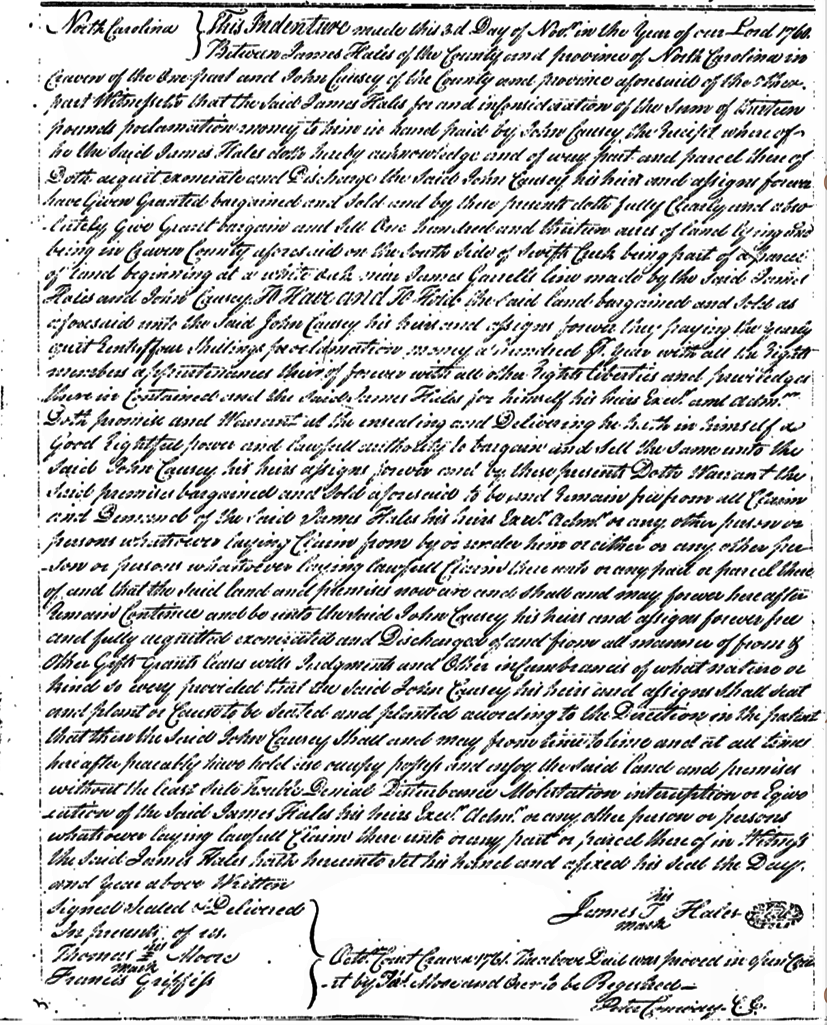
| LAND DEED TO JOHN CAUSEY 1760 |
Only a few years later in 1760 John Causey, son of Philip I of Dorchester, having divested his assets in Maryland, bought 113 acres on Swift Creek in Craven County from James Hales. He sold this land to Thomas Tutin a year later 1761. (Craven County, North Carolina Deeds & mortgages, 1708-1918; index to deeds & mortgages, 1708-1960). John was soon followed to North Carolina by other members of his family. Father Philip, probably soon after the passing of his wife Mrs. Mary, made the trip down to son John’s place. I would venture the move was probably by boat along the coast from the Chesapeake down the coast to the Neuse river and up to the nearest landing to John’s land on Swifts Creek. John and Ann bought and sold numerous tracts between 1760 and 1790. John’s sons Philip, John, and Absalom were all born in Dorchester County, Maryland but grew up on Swifts creek there in Craven County, North Carolina. Neighbors included the Isaac and Sarah Stocks and family, who provided daughters as wives for several of our Causey boys.
John, Sr.’s brother Philip II had purchased land in Edgecombe County, the second county northwest of Craven. In a petition to the Court of Craven County, Philip Causey II asks to be excused from duty as administrator of father Philip I’s estate. See if you can interpret fig.3 (Found in Craven County Estate Records, under Philip Causey Estate, 1778; Box 23.)
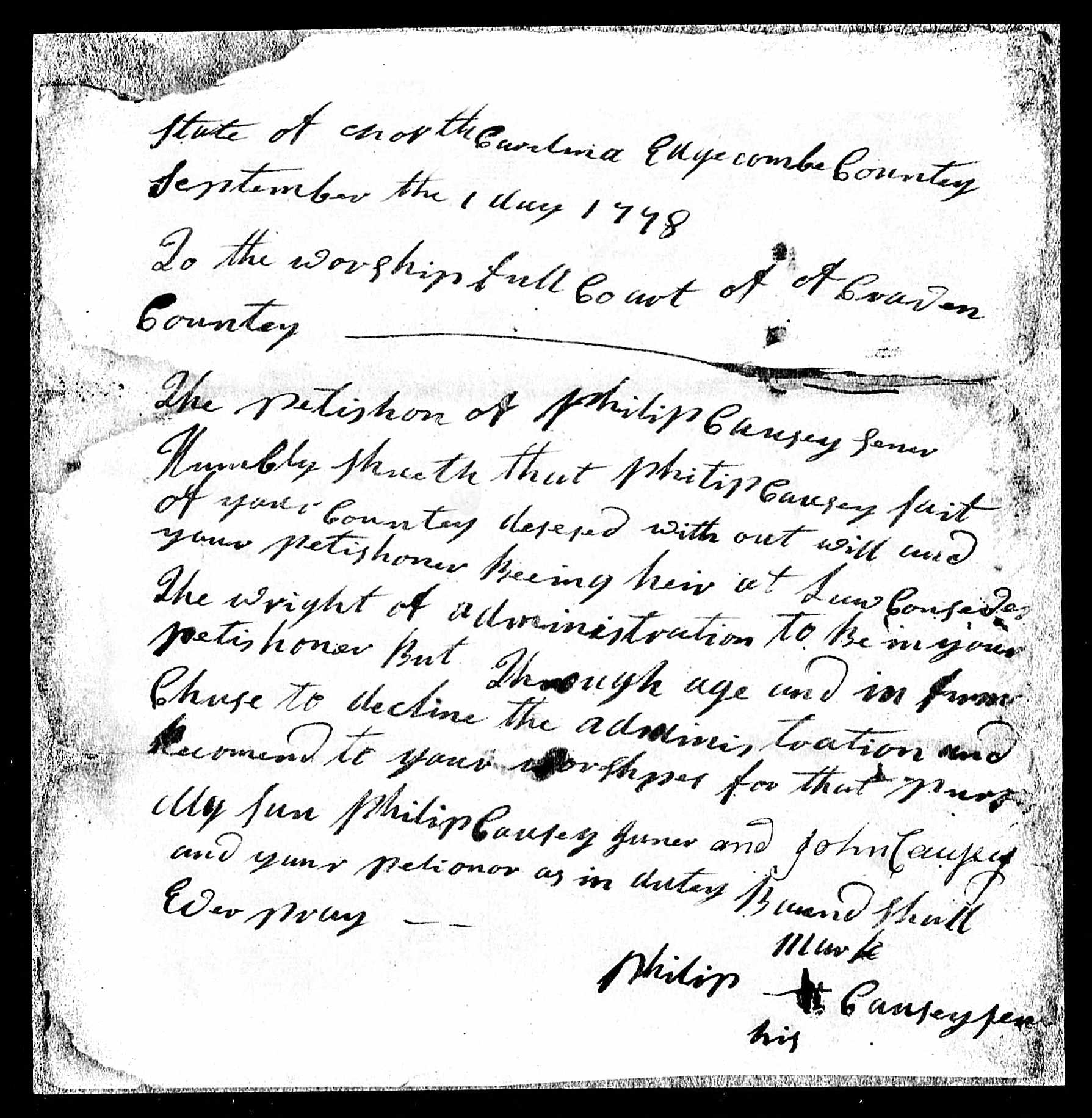
| Phillip Causey-II, Junior Petition to the Court of Craven County North Carolina 1779 for John Causey to administer his father Philip-I’s estate. |
An analysis of this petition shows Philip Jr.(III) to be living in Craven County next door to Philip II’s brother John. Philip I, having deceased in Craven County, Philip II asks that his son and brother administer the will. As it turns out, probably because Philip III had not reached majority, brother John alone administers the will. (John and Ann Causey also had a son Philip). All told we appear to have Philip I’s children and grandchildren in North Carolina. I won’t try to tackle the other sons of Philip II except to note that he probably not only had Philip III but another son Absalom. This Absolem, 1765-1800, appears to have lived much of his life in South Carolina and was married to Elizabeth Wood. (Note also CPT William Causey of Amite County, Mississippi fame, gave part of his granted lands in South Carolina to this Absalom Causey.) As you will see later, Philip son of John and Ann Causey will wind up in Randolph County, Georgia, always it seems to be close to his uncles and cousins.
John Causey of Dorchester, Maryland passed on in 1779 leaving the following Last Will and Testament:
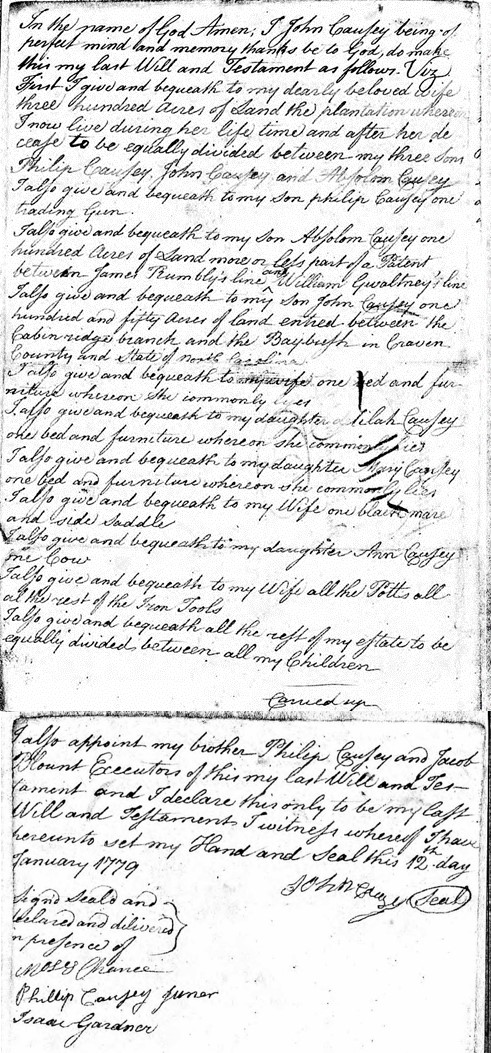
As can be seen from the witness signatures above, Moses Chance was a close friend of John and Ann Causey. Also, John Causey signed his LWT signifying his ability to read and write. His nephew Phillip Causey-III, Juner also witnessed his will as did Isaac Gardner. So, this John Causey of Craven County, North Carolina was most likely son of Philip Causey-I and the brother of Philip Causey-II, Sr.
John Causey and Ann his wife had at least three sons. As was customary back then, the first son was named after John Causey, Sr.’s father Philip I. His second son, also customary, was named after him. The third son, Absolom, if also following custom, would have been named after his wife Ann Wilcox Kirk’s father.
Deeds tell us a lot about our family ancestors. Families were close, not only caring for each other but also sticking together geographically. John Sr. and sons John Jr., Philip, and Absalom all lived adjacent to each other on Swifts Creek several miles northwest of Newbern, North Carolina. John Causey, son of Philip I, of Dorchester County, Maryland, deceased in 1779, in his Will left much of his estate to his wife Ann.
Recently there has been raised a significant question in my mind regarding Ms. Ann Wilcox Kirk Causey. I have not taken time as yet to flush out all the possibilities but have come to the conclusion that if Johns spouse Ann as listed in his will, is in fact Ann Wilcox Kirk Causey, then it is not reasonable to assume she was the spouse who accompanied John from Maryland to Craven County, North Carolina. Recent research outlined in Appendix I, Section II, Notes on Ann Wilcox Kirk Causey provide strong evidence that her son Roger Kirk was most likely the son of John Kirk who drown in the Tar River about 1757. Furthermore, since no other Willcocks (Wilcox) families can be found in Craven County, North Carolina during the period 1750-1800, Ann Wilcox Kirk most likely is the daughter mentioned in the LWT of John Willcocks. The question then becomes, “Are John, Phillip, and Absalom the children of a first marriage in Maryland?” More research may provide answers.
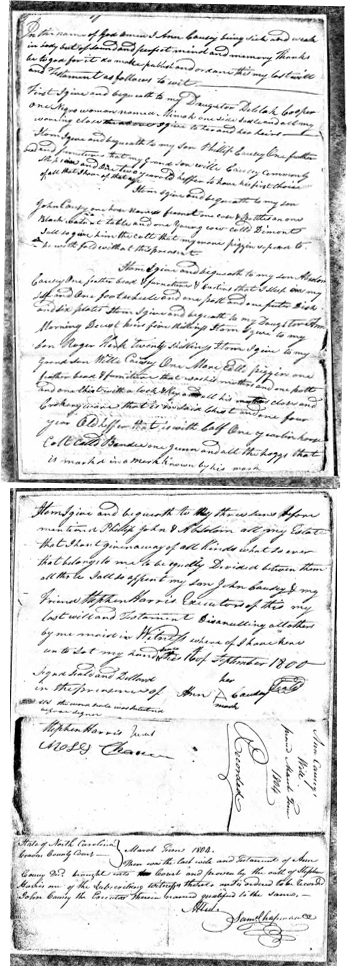
Mother Ann Wilcox Kirk survived her husband John another 24 years. In 1790 she distributed most of the 300 acres John Causey had accumulated to her boys Philip, John, and Absalom. What was left she bequeaths in her will, “Ann Causey, 1804, (Found in the Craven Co., NC Wills; NC Archives, Raleigh, NC.) Soon after her passing, her sons Philip and Absalom begin selling their properties, getting ready to move south.
John may also have moved south but there is evidence he probably remained there in Pitt or Craven County, North Carolina where his descendants still live. One interesting caveat is the story of his service during the American Revolution as described by John A. Clark, “During the war young John Causey went to sea. He served as a member, along with one of the young Gwaltneys, of the crew on the ship “General Nash” that sailed out of New Bern under papers or letter of Marquee (a privateer) and captured three British Ships in 1776 and 1777. The captured ships were brought to Port Beaufort as prizes to be sold (Craven County records in the N.C. Collection at ECU Library).” Transcribed from papers in the John A. Clark Collection, No 427. East Carolina Manuscript Collection, J.Y. Joyner Library, East Carolina University, Greenville, N.C.
October 1780 found John Causey, Jr. still aboard the General Nash. Again in September 1780 the Privateer General Nash out of New Bern captured three more ships under English flag. The following document outlines the agreement of the crew to their share of the spoils:
“Mariners and Marines of the General Nash, 1780
New Bern, October 24, 1780
KNOW ALL MEN BY THESE PRESENTS, That, Whereas the PRIVATE SHIP OF WAR called the GENERAL NASH on her late cruize against the British enemy hath taken and brot safe into PORT BEAUFORT three prizes, to —wit:, THE BRIGG AGIE, THE BRIGG PRIINCE OF WALES, and THE BRIGG KITTY with valuable cargoes on — board each of them;
NOW, KNOW YE, That we the subscribers, late mariners and marines on board the said GENERAL NASH in her said cruize, reposing special trust and confidence in Captain Daniel Deshon and William Tisdale have appointed and we do hereby constitute and appoint the said Captain Deshon and William Tisdale to be our agents and to act for us and in our room and stead, to receive all goods, wares, and merchandise, and all sums of money arising from the three above prizes and, their cargoes, boats, &c, which shall fall to our respective shares;
And we do further covenant and agree to allow to our said agents five percent on all such goods, wares, merchandise and sums of money arising as aforesaid as a full compensation for their trouble for receiving and paying and delivering to each of us our respective shares in the above prizes;
Charles Williams, John Fowler, Roger Galaspie, John Murphy, William Willcock, Daniel Auston, Isaac Farrow, Jacob Farrow, Harper Howard, William Tare, Sam Gelff, John Francois, Michael Egan, Louis Ince, William Capps, David Warsley, James Taylor, John Causey, Sam Gardner, Benjamin Northam, Thomas Miller, Roger Wrenn, Thomas Welch, William Castex, Simon Constock, George Meggs, George Ward, Theodore Hill, John Oliver, Ezekiel Everington, John Story, John Farnham, L. Reed, John West,. John Gourdon, John Blight, John Warner, Thomas Finigin, Antonio Wallace, Norman Montague, Solomon Hopkins, John Ford, Isaac Cunningham, John Morris, Thomas Clark, John King.
New Bern, October 26, 1780
We do hereby certifie that Richard Cogdell, Jun. shall receive one third of the commissions arising from the half part of the three Prizes taken by the ship GENERAL NASH as we are appointed by the majority of the crew to act in their behalf.
William Tisdale De. Deshon”
Source: Extract from FamilySearch.org; https://www.familysearch.org/library/books/records/item/436339-king?offset=3
A follow-up report was also sent to the North Carolina Governor:
“Letter from Richard Cogdell to Abner Nash
Cogdell, Richard, 1724-1787
September 04, 1780
The state records of North Carolina. v.15 1780-81. North Carolina Volume 15, Pages 68-69
________________________________________
COL. R. COGDELL TO GOVERNOR NASH,
New Bern, 4th Sept., 1780.
To His Excellency Abner Nash, Governor of North Carolina.
Sir:
The inclosed I rec’d on Saturday last by post, which made it necessary to send Express, as they may contain matters of consequence which you would chuse to lay before the Assembly. I also send you your last Neuse papers, & I have the pleasure to inform your Excellency that the private Ship of war, Gen. Nash, has brought safe into Port at Cape Fear two Valuable Briggs—prizes—one from a Port in Scotland, with the best assortment of every necessary. I have seen the Invoices of both prizes, the one from Scotland £10,800 prime lots sterling, the other from St. Christopher, with Rum and Sugar and many other valuable Articles, to Amt. of £40,000. Both were bound to Augustine or Charles Town. The best prize was taken four days after the ship got out to Sea, the other in a day or two after, about 12 leagues from Charles Town Bar, without firing a gun. As Cape Fear is not a safe Harbour, Contrary winds drove them in, but Capt. Deshon is gone to convey his prizes into Ocracock or Old Topsail. Everything that can be named for the use of the Army is on board; 300 bls. Flour, besides the Invoice.
I have the honour to be
Your Excellency’s obedt. Servt.,
R. COGDELL.
John Causey, Junior, son of John and Ann Causey of Craven County, North Carolina, while not an Enlistee nor Officer in the Continental Army or Navy, contributed much to the success of George Washington and the Independence of our United States of America.
Absalom and Frances Stocks Causey and the story of the selling of her land dowry
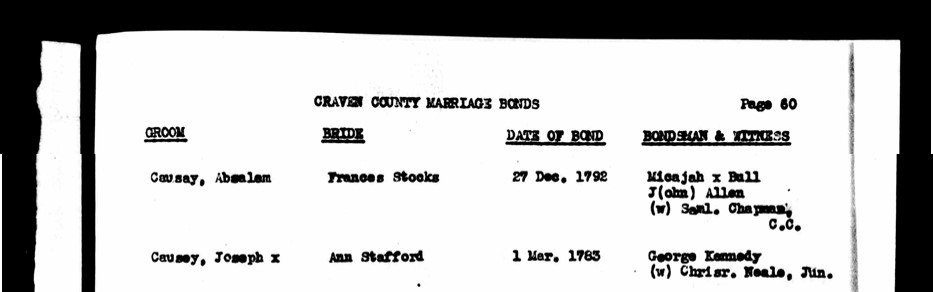
| Craven Co. NC Marriage Bonds – Absalom Causey and Frances Stocks 27 December 1792 |
Absalom Causey and Frances Stocks, daughter of Isaac Stocks were married just after Christmas 1792. Absalom had applied for and received in 1794 a grant of land adjacent to his father John Causey’s old place. Absalom’s bride had received a dowry left her by her father Isaac STOCKS. They both agreed to sell this, “parcel of Land lying and being in the County of Pitt on the North side of Swift Creek & North Side of Turkey Cock Swamp,” had been “the Land & plantation where Isaac STOCKS Desceased formerly lived Containing four Hundred Acres more or less.”
Absolum Causey and wife Frances to Shadrach Allen, April 28, 1794
Pitt Deed Book N, p. 157
This Indenture made This the 28th day of April One Thousand Seven Hundred and Ninety Four Between Absolom CAUSEY & Frances CAUSEY his wife of the State of North Carolina and County of Craven of the One part & Shadrach ALLEN of the same State & County of Pitt of the Other part Witnesseth that for and inconsideration of the sum of Forty five pounds to them in hand paid by the Said Shadrach ALLEN the receipt whereof they do hereby Acknowledge themselves fully Satisfyd & paid hath Bargained & Sold & by these presents do Bargained sell set over & Confirm unto the said Shadrach ALLEN A Certain tract or parcel of Land lying and being in the County of Pitt on the North side of Swift Creek & No Side of Turkey Cock Swamp Joining the said Shadrach ALLENS Own land It being the Land & plantation where Isaac STOCKS Decd. formerly lived Containing four Hundred Acres more or less part of the said Land and plantation Pattend by Isaac STOCKS & a part purchased of Shadrach ALLEN decd. & the Half of the sd. Land & plantation Conveyed by the said Isaac STOCKS to his Daughter Frances STOCKS by the Last Will & Testament of the said Isaac STOCKS and we the said Absolom CAUSEY & Frances his Wife do Warrant and forever Defend unto him the said Shadrach ALLEN his Heirs & assigns for ever the Half of the said Land and Plantation which being Two Hundred Acres more or less from our Heirs our selves Administrators or Assigns to have and to hold the said Land & premises with every profit & Advantage thereunto belonging with all Buildings Orchards Fields & fences water & water Courses unto him the said Shadrach ALLEN his Heirs Exctrs. or Assigns forever & we the said Absolom CAUSEY & Frances CAUSEY do warrant & forever defend the said Land & premises from the Lawfull Claim or Claims of any person or persons Whatsoever
I Witness whereof we have hereunto set our hands & Seals the day & year first Above Written
Signed Sealed & Deliverd Absolom (his mark) CAUSEY {Seal}
In presents of —— Frances (her mark) CAUSEY {Seal}
J. COART
Simon BURNEY
Can SMITH
Ordered to be Registered April Term 1794—-
State of North Carolina Pitt County
Agreeable to Order of Court April Term 1794 to me directed to Examine Frances CAUSEY on the Conveyance of Land. I hereby Certify that Frances CAUSEY Came before me on the 20 of June 1794 and being Privately Examined that the Deed above Conveyed by her to Shadrach ALLEN for 200 acres was of her own Free will & accord and that she was not forsd. into the Act by thret but did it of Choice given under my hand this 20th of June 1794 J. COART JP
(Note: The deeds are found in the Register of Deeds office, Pitt County Court House.)
The sale of Frances land dowry provided a decent financial foundation for the couple. Absalom and Frances Causey had already begun their family for in 1793, John Causey was born. It was the custom to name the firstborn son after his paternal grandfather, in this case, John. British naming convention provided that the first son was named after the paternal grandfather, the second son was named after the maternal grandfather, the third son was named after the father, the fourth son was named after the oldest paternal uncle, the fifth was named after the second oldest paternal uncle or the oldest maternal uncle. On the mother’s side, the first daughter was named after the maternal grandmother, the second daughter was named after the paternal grandmother, the third daughter was named after the mother, the fourth daughter was named after the oldest maternal aunt, and the fifth was named after the second oldest maternal aunt or the oldest paternal aunt. Births were strung out over the next twenty years with a Christopher born more than three years after John. These breaks often occurred due to miscarriages and stillbirths. Even children lost to accidents, flu or other adolescent diseases often did not leave a record of their existence. Christopher born in 1797 was followed by Elizabeth in 1800, William 1802, Wright 1808, Margarete 1810, James S. 1812, Mary 1818, and possibly Nicey in 1824. Making life especially difficult for Frances during her child bearing years was the moves from Craven County, North Caroling across Georgia. Evidently Frances Stocks Causey passed away somewhere in Georgia, probably in Jones County. She was about 60 years old.
The Causey Brothers Move to Georgia and Absalom’s Last Days
Philip Causey I of Dorchester County, Maryland along with sons John and Philip II and their families, driven by “that restless, nervous energy” had packed their goods and with their wives and children departed Dorchester County, Maryland joining those brave settlers who with their rugged individualism were ready to face the challenge of the frontier. After the passing of his dear wife Mrs Mary, Philip I had followed son John to Craven County, North Carolina sometime before 1760. Unlike traversing the “Great American Desert” in “prairie schooners”, our Causey ancestors moving south from Maryland were able to move over ocean waves and paddle up rivers and creeks to distant landings on the new frontier. There in Craven County, Philip I, son John Causey and Johns wife Ann lived their new lives for many years. Inevitably, they had all passed away by 1804. And, though they had been born in Maryland, North Carolina had been the home for John Jr., Philip, and Absalom Causey for nearly fifty years. The Great American Frontier was calling. The crop lands of North Carolina had been used up. Trapping game was getting harder and the place was getting crowded. The brothers John, Philip, and Absalom were moving on. Maybe there had been reconnaissance visits into Georgia. More likely some close friends or relatives had already made the move. Ezekiel Causey was in Jefferson County, Georgia, probably a cousin. Possibly he had sent word that Georgia was about to open up the Cherokee Lands to settlement. Regardless of rationale, the process was a move from Craven County, North Carolina to Georgia sometime around 1810.
About 1820 Absalom Causey, son of John and Ann Causey, led his family from Craven County, North Carolina, to Jones County, Georgia where they lived until at least 1830. President Jackson was intent on moving the Great Five Indian nations (Cherokee, Choctaw, Chickasaw, Creek, and Seminole) to Oklahoma to open land in the deep South to settlers. The Causey boys were eager.
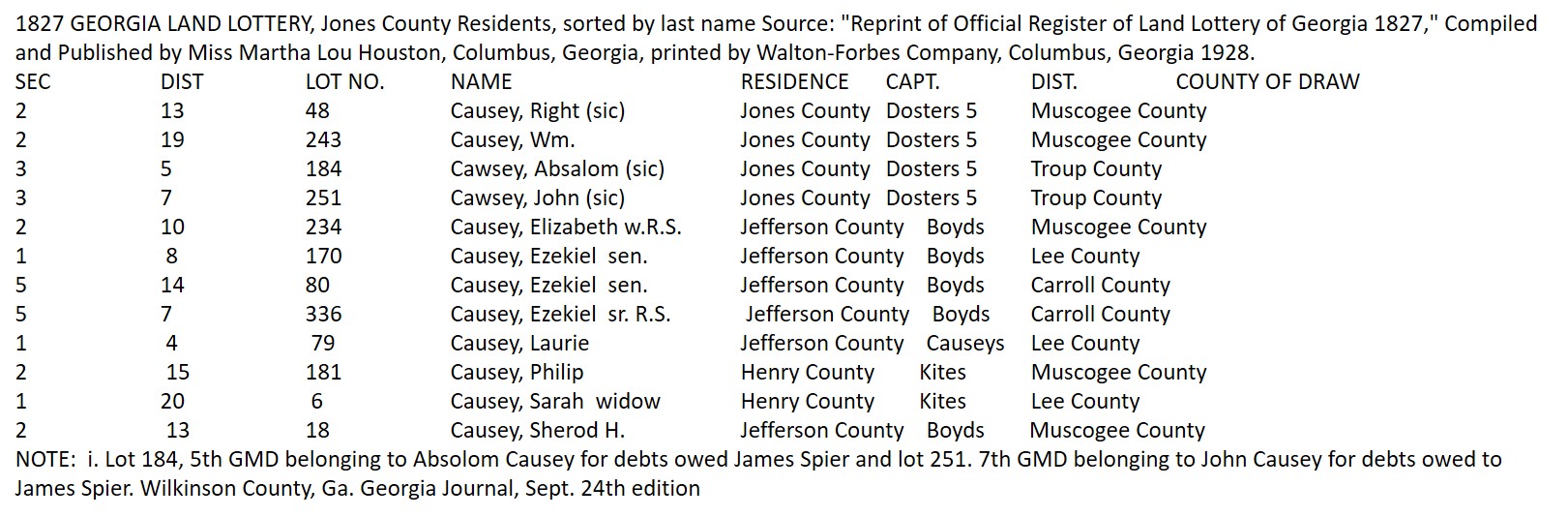
In about 1828 Absalom and sons Wright, William, and John all received land in the 1827 GEORGIA LAND LOTTERY. (Note: It is not clear whether this John is Absalom’s son or brother but probably his son. His brother John most likely remained in Craven County, North Carolina after the death of his wife and mother. The 1815 Craven Tax Lists shows a John Casy with 50 acres. See “List of taxables in Captain William C. Nelson’s district, Craven County A.D. 1815: Casy, John 50 acres.” [Source: 1815 Craven County Tax Lists, transcribed by Victor T. Jones, Jr., Local History and Genealogy Librarian, New Bern-Craven County Public Library, copyright 2006, all rights reserved]). Philip Causey, Absalom’s brother also won in the lottery, (Name: Philip Causey – County: Muscogee – Captain’s District: Kites – Number: 181- District: 15.) Absalom Causey’s family were all living in Jones County and had been residents there for at least three years as the lottery rules required. Absalom acquired 202.5 acres in Section 3, District 5, Lot Number 184, (marked by the red circle on the map).
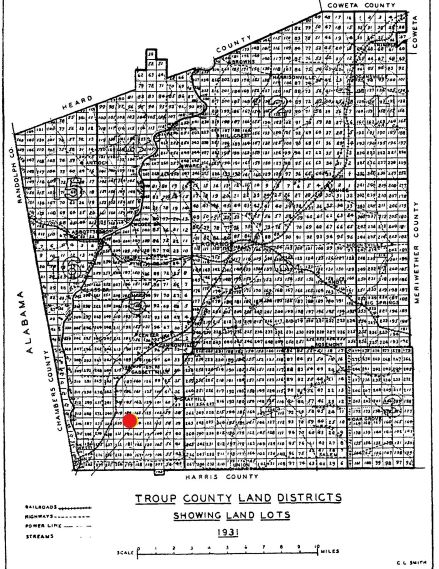
| Absalom Causey’s 202 acres marked by red circle |
Absalom’s Lot 184 was less than 5 miles from Chambers County, Alabama where he would finally be laid to rest. This is the last land record found in Absalom Causey’s name. Regretfully, I found the following in the book Spear, Speir, Speer and Friends, Author George Spear, Publisher G. Spear, 2001: Page 188, “Troup County, Georgia.. August 28th….Macon Messenger prints certain properties will sold to satisfy debts. Lot 184, 5th GMD belonging to Absolom Causey for debts owed James Spier and lot 251, 7th GMD belonging to John Causey for debts … .” So apparently sometime mid to late 1830s both Absalom and John Causey lost their land in Troup County, Georgia.
If you have read previous chapters you are aware that John and Ann Causey of Craven County, North Carolina had three sons Philip, John, and Absalom. We stated previously that after John and Ann past away, several of the children moved on to Georgia then to Alabama. Well, while they were living in North Carolina, their neighbors were the Isaac Stocks family, including Susanna and Frances. Susanna married Philip Causey in 1791 and Frances married Absalom Causey in 1792. In the 1820 US Census for Burke County, Georgia is listed one Philip Causey showing two male family members who were 45 years and older. Could one of these be his brother John Causey? It is clear that Philip and Absalom who married the Stocks sisters moved close to one another as they moved west. Philip and Susanna’s son Phillip, Jr. was married in Green County (next county north of Jones County where his 2nd cousin Absalom and his boys lived) and is shown to be in Randolph County Georgia for the 1870 US Census. Absalom Causey’s sons continued their move west into Alabama but most of his brother Philips descendants remain in southern Georgia.
The Absolom Corsey (sic) Causey listed in the 1830 Jones County, Georgia Census is probably Absalom Causey, son of John and Ann Causey. The Census shows one male age 60-70 (Probably Absalom b. abt 1762) and one male 20-30 (Possibly James S. Causey, b. 1812). The move to Troup County must have been soon after the 1830 Census. Some of the family moved over to Chambers County Alabama soon after 1830. Land Patents show Wright Cossey (Causey) received two patents in Township 24, Range 25 totaling 80 acres. However, Absalom and William were still listed on the Troupe County, Georgia Militia roster as late as 1836. So it had to be about that time Absalom Causey moved on to Alabama.
| “In 1861 he (Johnson Jones Hooper), was appointed Secretary of the Confederate Congress and died, prematurely, at Richmond, Virginia, while attending these duties. Extensive research has failed to reveal the exact location of his home in Chambers County, however, it is known that he resided between present day city of Abanda, Alabama on the road leading by Leverett’s Mill to Shiloh Church. On the 13th day of July 1837, his near neighbors were listed as: John McKnight, G.W. Jarvis, Pleasant Jones, Henry G. Turner, John C. Looser, Absalom Causey, Wright Causey, Green J. Sorrel, J. F. Henry, Thomas Willoughby, John Jacks, Tom Bridges, Jacob Bailey, John Tredwell, William Richards, David Treadwell, John Bently, E. Hamby, Frances Pearson, William Pearson, J. E. Boalt, Wm. Smith, R. Patten, Robert McKnight, Hugh McKnight, Zachariah McKnight, David Hudgins, James Jones, Mark Thomason, Moses W. Green, Joseph Hancock, Jackson Fant, Mason Day, John W. Jarvis, John Bean, Isham Nelson, John Nabour, Sima Bryan, James Hodnett, J. W. Bachelder, A. B. Camp, G. W. Hopkins, Wm. McNeeley, William Flemeing, and Isham Hall.” |
| “In June, 1836, the following petition was presented to the Commissioners Court: State of Alabama ) Chambers County ) We whose names are hear unto subscribed beg leave to Peteion the Honourabe Commissioners Court of road & revenue to be on the First Monday in February next at LaFayett For Reveiuers to mark & Lay out a Road Commenceing on Section Five (5) Township Twenty Four (24) & Range Twenty Seven (27) Thence the best Pratable Rout to Section (21) on the Tallapoosy to McKnight & Richards Ferry should your Honourable Body grant our Request you Petietioners will in Duly bount ever Pray John McKnight, Wright Causey, David Treadwell, Andrew M. McKnight, Thomas Willaby(Willoughby), Absolom Causey, John Jacks, John Treadwell,G. T. Sorrell, John J. Fielder,E. Sorrell, Thomas McClendon, Jacob Beck, Wm. Treadwell, Wm. L. Taylor, Wm. Richards, A. Edwards, Young Jacks” |
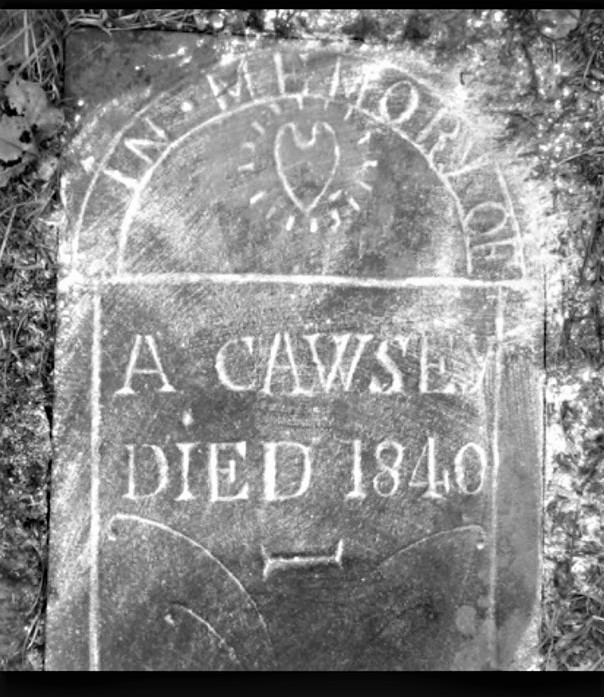
| Absalom Causey headstone at Mount Olive Cemetery Chambers County, Alabama |
Furthermore, based on the fact that I’ve found no land transactions in the name Absalom Causey in Alabama, It is probable father Absalom moved in with son Wright, spending his final few years in the community around Shiloh Church. If this is true, Absalom Causey died before the 1840 census was taken. In the 1840 census there were no males listed past the 30-40 age for Wright, Christopher or William Causey in Chambers County Alabama. In the same 1840 census the next county over, (Coosa County), lists John, Ezekiel, and Thomas Causey. The John Causey in Coosa County 1840 might be the first son of Absalom but more likely John, Ezekiel and Thomas were children of Ezekiel Causey who died over in Jefferson County Georgia in 1821. One Family Tree list sons Ezekiel, John, Allen and Israel as sons of Ezekiel d.1821. Nevertheless, none of them in Chambers or Coosa Counties listed any males older than 60. So it seems likely that Granpa Absalom Causey is in fact buried there under the stone marked “A Cawsey 1840” in the Primitive Baptist Cemetery there in Chambers County Alabama. But since the church itself burned down with (presumably) all records included, there is no way to prove or disprove this theory. The stone remains as a monument to the life and times of Absalom Causey, born in Craven County, North Carolina about 1762, married his sweetheart Frances Stocks in 1792 , moved on to Georgia then Alabama where his adventures ended, (or maybe just moved to a better neighborhood). (Find A. Cawsey Grave Memorial #: 48488715, Burial: Mount Olive Cemetery Chambers County, Alabama, USA.) “Mt. Olive Baptist Church Cemetery” is located on YMCA Camp Road at the orginial site of Mt. Olive Church,8120 Co Rd 53 Wadley, Alabama . The final burial in this cemetery was in or around 1925. Today, this cemetery is known as “Old Mt. Olive Church Cemetery.”
By 1850 the Sons of Absalom Causey Remained Fairly Close Geographically
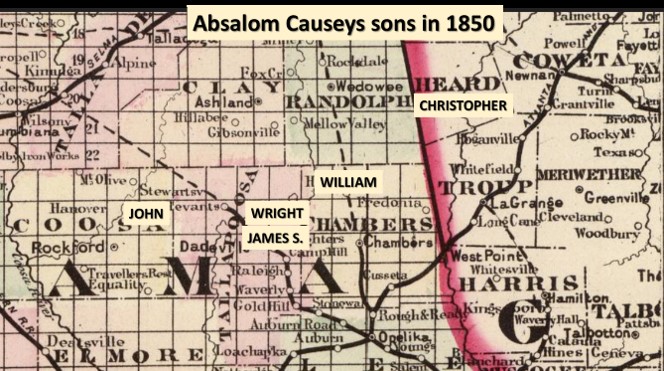
The draw of the West in the minds of the “Causey Boys” continued. We will see the branches continue to grow and spread for the next century in the following chapters.


Leave a Reply