
This section begins with a grant of land to a “WILLIAM BERRIMAN, 150 acs. Accomacke Co., 6 Aug. 1635,… 50 acs. for his per. adv. & 100 acs. for trans, of 2 servts. called John Causey & Edward Prince.” (Cavaliers and Pioneers, pg. 30). (End Note 12)
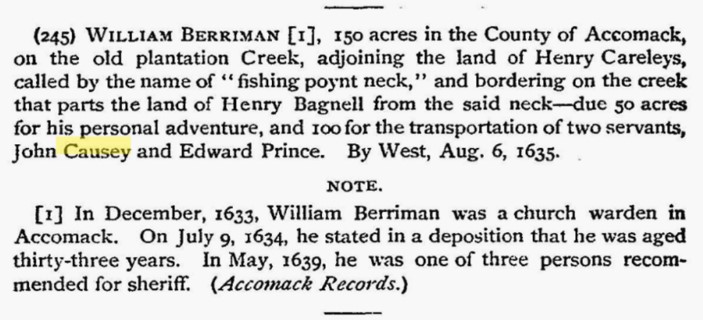
English servants were usually indentured during this period (4, 7,14, 21,or even 28 years). If this John Causey having served maybe seven years and if he were at least 21 when he arrived in America, he would have been about 28 years old when he received his “free agency”. He would then probably have looked to the north and Maryland where new land grants were available. With this scenario we can postulate that this John Causey, probably English but who very well could have been Irish, found a wife and began his life in America in Maryland sometime between 1640 and 1649. Like many others he could very well have found his way up the Accomack through Somerset, Queen Anns, and on to Dorchester County, Maryland. I say Dorchester because I can pretty much trace our particular Causey ancestry to Dorchester over Causey families in other counties in Maryland as we will come to understand later. I have no evidence that this John Causey could have become the “Planter” in Dorchester County, Colonial Maryland by the 1670’s. There is, I believe, significantly more evidence that would lead to a conclusion that the Causeys of Dorchester County are descended from Nathaniel and Thomasine Causey of the Jamestown Virginia Colony.
Thomas Causey remains in Virginia. According to Bowen Dees, “Another Causey – Thomas – is shown (not as part of Nathaniel’s household, but living alone) in the -1624 Muster for Jordan’s Journey. This may be the Thomas Causey shown as having been transported to the colony by Captain John Ashton; Thomas arrived in Virginia in 1620 on the Francis Bonaventure, according to the Jordan’s Journey Muster. He bought or was granted a number of tracts of land in the 1630’s, but there is no record as to his parentage or his heirs. He may also have been a son of Nathaniel and Thomasine — or perhaps a brother of Nathaniel’s.”
The following items are documented mentions of Thomas Causey in Colonial Virginia:
- Thomas Causey arrived in Virginia, “Francis Bonaventure” in 1620. He married Jane . (Cavaliers and Pioneers of Va. p. 123.)
Feb. 1623. 4 V 426 Thomas Causey was living at Hog Island,.
1624-5 Thos. Causey was living at Charles City.
1635 Governor Harvey granted to Thomas Causey 150 acres in the neighborhood where Nathaniel Causey or Causy had lived. He was probably a son.
July 14, 1637. Abstracts of the Va. Land Patents. Thomas Causey in the County of Charles City 30 A. beginning at the mouth of the Appomaox, at the south side. Due for transportation of 10 persons. Granted July 14, 1637.
April 18, 1635. 9 W (1) 228. Patents issued. Thomas Causey 150 acres in the Indian Field bounded on the north of Jordan’s journey.
July 14, 1637. 9 W (1) 229. Thomas Causey, 500 acres at the mouth of the Appomatox at the south side.
July 14 1637.7 V (9). To Thomas Causey 500 acres, 300 at Mouth of Appomatox south side at Causey’s Field Creek, 200 beginning at Causey’s Field Creek adjoining Captain Francis Epes, Transportation 10 persons.
I have not been able to connect Jamestown’s Thomas Causey above with a following generation Thomas Causey of Dorchester County Colonial Maryland. As of 1638 Thomas Causey remained in Virginia.
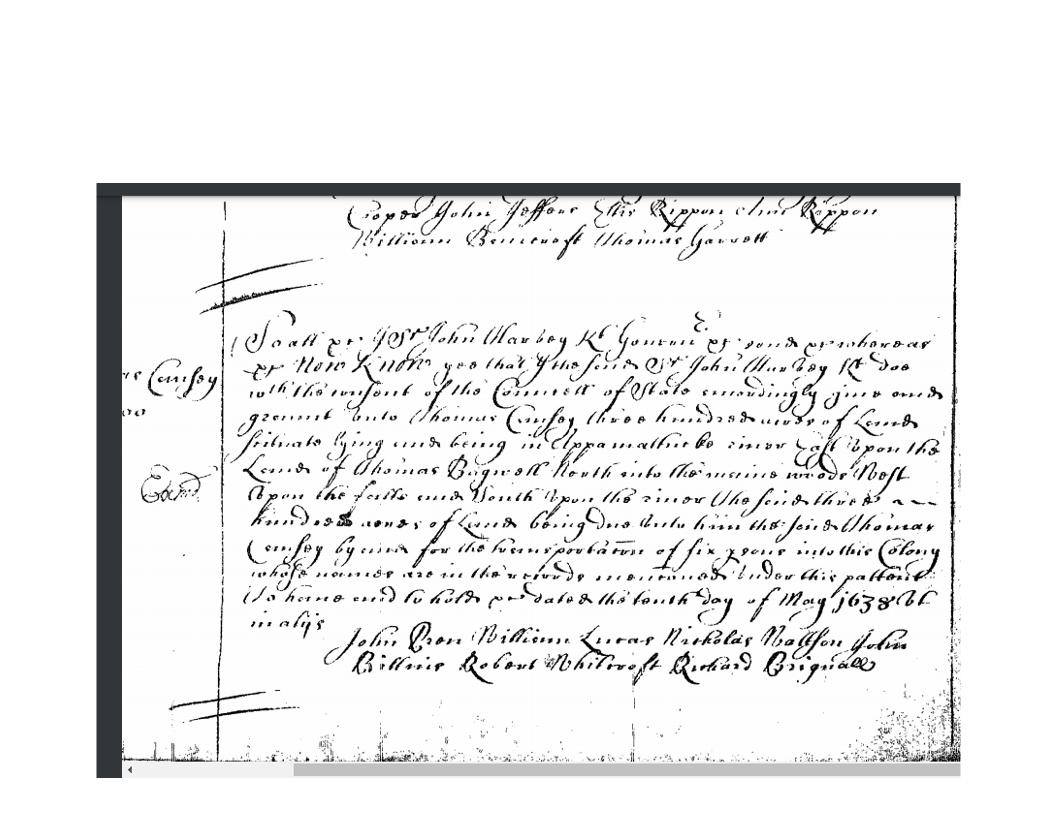
John and William Causey leave Jamestown for the green pastures of Maryland.
I have concluded that John, Thomas and William are most likely sons of Nathaniel and Thomasine Causey of Jamestown colony. Nathaniel Causey was a “Gentleman Planter”. His sons would therefore also receive such designation. I want to take a look at the third colony to be established in America after Jamestown and the Plymouth colonies. That would be the Isle of Kent.
Before Dorchester County there was KENT COUNTY AND KENT ISLAND
The following extract is from The Isle of Kent Virginia Colony and Province of Maryland presented by USGenNet Patrons Rhoda Fone & Carole Hammett in 2001. (See the following link: http://www.usgennet.org/usa/md/state/isleofkent.html ).
“On 29 Jan 1620/1, Sir Francis wyatt was elected Governor and Captain General of Virginia Colony at a court of the London Company, When he arrivedin Virginia in Oct 1621, he was accompanied by William Clayborne who had been appointed Surveyor-General. In 1626, when Sir George Yeardley was re-appointed Governor of the Colony, Clayborne was appointed its secretary of state and became a member of the Governor’s Royal Council. The following year, the Governor directed Clayborne to explore the Chesapeake Bay, and one year later, in 1627, he was granted a license to trade “in those parts of America for which there is not already a patent granted to others for the sole trade.” Clayborne established his post on the Isle of Kent, and in 1631, he and the Rev. Richard Jones (Church of England) began to settle the island.
On 20 Jun 1632, however, the Isle of Kent was included in the boundaries described in the charter for the new province of Maryland granted by Charles I to Lord Baltimore (Calvert). When Clayborne resisted Lord Baltimore’s claim to the island, the proprietor ordered his brother, Leonard Calvert, Governor of Maryland, to seize the settlement, and it was following this dispute that new Virginia Governor John Harvey deposed Clayborne as Secretary of State. The Isle of Kent nevertheless remained a Protestant bastion and a thorn in the side of Maryland for many years to come.”
Based on the historical information above I now refer to the MARYLAND HISTORICAL MAGAZINE VOL. VIII. MARCH, 1913. No. 1., KENT COUNTY AND KENT ISLAND, 1656-1662, written by Bernard C Steiner, LINK: https://msa.maryland.gov/megafile/msa/speccol/sc5800/sc5881/000001/000000/000029/pdf/msa_sc_5881_1_29.pdf . We now find the most likely connection between John and William Causey of Jamestown colony, Virginia and John and William Coursey, (Causey), of Kent County, Maryland. (The spelling of the surname Causey for hundreds of years depended on the scribe who spelled words phonetically. So, the Causey family in America can trace blood kin back to names like, Coursey, Casey, Carsey, Kersey, Cossey, Cawsey, etc. That’s why DNA, especially Y-DNA has become important in genealogy of late.) So, there is no reason to believe that the John and William of Kent County are different blood kin from those of Dorchester County. In fact, part of Kent County, Maryland became Kent County, Delaware and part of Dorchester County, Maryland. There were (and are) Causeys in all three. One became governor of Delaware. Following is an extract from page 2 of the magazine cited above:
“During the early part of the period, the Province was in revolt from Lord Baltimore and was governed by a Board of Provincial Commissioners, one or two of whom always sat in the County Court. This Board appointed the justices of the peace and the court met at the houses of the residents of Kent Island until December 15, 1658, when we find it meeting in the Court House. However, on August 7, 1661, it met at Thomas Einggold’s house. (Foot Note):The members of the Court were Philip Conner, November 1, 1656; Captain Joseph Wiekes, November 1, 1656; Thomas Ringgold, November 1, 1656; Henry Morgan, November 1, 1656; William Elliot or Ellioyett, November 1, 1656; Thomas Hinson, November 1, 1656; Russell, November 1, 1656; Edward Lloyd, November 19, 1657; Samuel Withers, November 19, 1657; Henry Carline, Thomas Bradnox, September 1, 1658, Seth Foster, September 1, 1658; Robert Vaughan, November 10, 1659; John Coursey, December 1, 1660; William Coursey, December 1, 1660; James Ringgold, December 1, 1660; William Leeds, December 20, 1860. (The dates indicate when the man first sat.)
My conclusion based on the above information is, because there is no mention in Virginia of John and William Causey after 1634 and the selling of Causeys Cleare to Mr. Aston, they relocated to the new settlement of Kent County, Maryland. They could have arrived in Dorchester County by individual immigration from England but I believe the evidence points to a direct lineage back to Nathaniel Causey. Regardless of how, our Causey ancestors did arrive in Kent and Dorchester Counties, Colonial Maryland not later than the 1650s where our two scenarios merge. If this John Causey, who we will refer to as John Causey-I, was the son of Nathaniel Causey of the Jamestown Colony, and sold Causeys Cleare February 7th, 1634, he would have to have been born say 1613 to have reached majority (21 years old) by 1634. The same would have been true for William Causey-I. They would have married between 1635 and 1645, very likely would have had sons, probably several during the 1650s. I can speculate those sons to be William-II and John Causey-II of whom we will take a closer look. I begin here to use Roman numerals to designate various Causey individuals since the Causey family names recur repeatedly in subsequent generation then until now. (My son and grandson have the name Thomas).
Noted earlier, there was a John Causey in Dorchester County who made his will in Dorchester County, Maryland in 1692 which was proved in 1698, (End Note 14). This could be John Causey servant to William Berryman. But more likely it is the son or grandson of Nathaniel Causey. Here’s what Cousin Bowen Causey Dees had to say, “(There were other Causeys in nearby, Worcester County, Maryland about this time, but we shall focus on Dorchester County, for it is well-nigh certain that our “line” of Causeys lived there until just before the American Revolution.) John Causey may have been our forebear. He, John Booth and Col. Charles Hutchings were connected in various ways. John Causey’s will made Charles Hutchings his heir. John Booth witnessed that will – and he bought land from John Causey; he also sold Land to Charles Hutchings. Col. Hutchings sold 400 acres of land to William and Abigail Smith – land that in due course was sold (in part) to Philip Causey, a man that is shown below to be our forebear. There is some room for speculating that John Causey’s daughter married Charles Hutchings, for John Causey’s will specified that his “temporall Estate of Lands, Cattel & Debts whatsoever” should all go to Col. Hutchings, excepting a mare That is wth fold wch mare and her Increase I Give to My Loveing Ms Ann Hutching to her heirs for Ever.” If Ann Hutchings were his daughter, this would be a reasonable provision. If she were not, why did he include this provision in his will? (Col. Hutchings was an important individual in Dorchester. He held various offices, and had considerable property. His daughter – the only child of which there is a record — married a Mr. Rider (sometimes spelled Ryder) and they had a number of children.)” Bowen Dees made it clear that John Causey-I was not of the servant class as he was very close to Colonel Charles Hutchins who was a Member of the Govenror’s Council, 1694 and an important person in Dorchester County. Furthermore, John Causey-II and William Causey-II are designated “Gentlemen Planter”, a designation reserved for those of aristocracy.
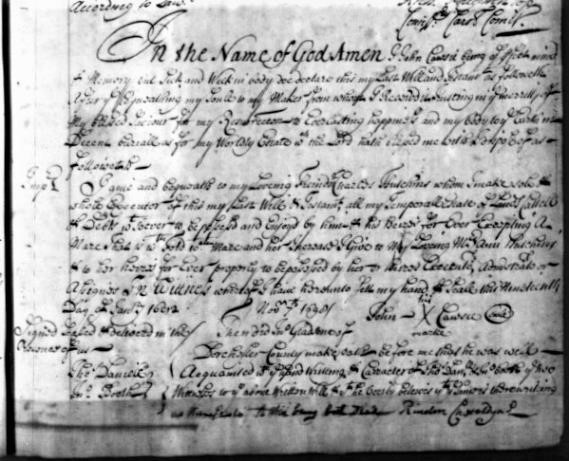
This John Causey we will call John Causey-I, partly because he’s the first Causey that we know of to die in Dorchester County, Colonial Maryland. And, because he may be John Causey-I son of Nathaniel and Thomasine Causey.
Now, the math. John Causey-I, indentured servant could have been as young as thirteen or younger when he arrived in Accomack. According to Encyclopedia Virginia, “Adults usually served for four to seven years and children sometimes for much longer, with most working in the colony’s tobacco fields.” Let’s assume John was a young adult who served four years. By 1640 he would have been about 25, b.1615. His death 1698 minus his birth 1615 birth date, would also make this John Causey about 83 at his death. We calculated John son of Nathaniel Causey to have been born about 1613 which would make him about 85 if he is the John Causey-I who died in 1698 in Dorchester County. Few lived past sixty in those days in America so there is possibly another generation between John-I and John-II.
We now can move from the possible toward the probable even documentable history of our Causey lineage. We will begin to dig into the land patents, wills, probate records, military records and cemetery markers that document the lineage from Causeys John II and William II of Dorchester County, Colonial Maryland to those Causeys of Guilford County, North Carolina to those of Tennessee and lately on to Bibb, Tuscaloosa, and Fayette Counties in Alabama.
John Causey-II
According to records in the Archives of Maryland, John Causey-II of Dorchester County, Colonial Maryland, was born about 1650 or earlier to have been living in Dorchester County Colonial Maryland and be of age by the late 1670s to own land and to have participated in the Militia Expeditions against the Nanticoke Indians in the wars of the 1670s when all “able-bodied” men between the ages of sixteen and sixty were required to be available for militia training and duty. NOTE: The Act outlined below indicates the payment to the Militiamen was for “the late Expedicon, (sic), against the Nanticoke Indians.” That would seem to exclude conflicts earlier than the ones of 1774-1778. (End Note 13). This John Causey, (there does not appear to be any other John Causeys in Dorchester County during that period of time) in 1682 received a grant of 100 acres of land which he named Causeys Choice. The Act also indicates payments to the Militiamen for “the late Expedicon, (sic), against the Nanticoke Indians,” “Late Expedition” would seem to exclude conflicts earlier than the ones of 1774-1778. Here is an extract of that Act granting 600 pounds of tobacco to John Causey-II of Dorchester County:
Proceedings and Acts of the General Assembly, October 1678 November 1683 (End Note 13)
“An Act for payment and assessing the Publick Charges of this Province Whereas There hath been Eight hundred twenty five thousand Nyne hundred Seventy Nyne pounds of Tobacco Expended layd out & disbursed by severall of the Inhabitants of this Province in the late Expedicon against the Nanticoke Indians and other the necessary Charges of this Province which bath been Examined stated and allowed by the upper and lower houses of this present Generall Assembly To the intent therefore That the same may bee satisfyed and payd to those persons to whom the same is due Bee itt Enacted by the Right Honble the Lord Proprietary by and with the advice and Consent of the upper and lower houses of this present Generall Assembly and the Authority of the same That the said Eight hundred twenty five thousand Nyne hundred Seventy Nyne pounds of Tobacco be paid in manner & forme as is hereafter Expressed by an Equall Assessment vppon the persons & Estates of the Inhabitants of this Province And be payd to the severall persons to whome the same is due as aforesaid Any Law Statute Custome or vseage to the Contrary thereof Notwithstanding-(pages skipped to Dorchester County list.)
Dorchester. To Capn Thomas Taylor Nynteen hundred pounds County Tob. To Leivt John Ross sixteen hundred pounds of Tobacco To Cornett Maurice Mathews fifteen hundred pounds of Tobacco To John Brooke seventeen hundred & fifty pounds of Tobacco To Wm Haslewood Eight Hundred pounds of Tobacco To William Willoughby seven hundred pounds of Tobacco To William Betts seven hundred pounds of Tobacco To John Alford To Robert Thornhill To John Thomas To John Nicholas To William Robsone To James Moseley To Richard Gallehaugh To Richard Tubman To Rowland Morgan To Phillip Aherne To John Pope To John Savage To Thomas Bowman To John Fish To Jonathan Waite & John Wallice To James Egg To John Richardson To Lewis Griffith James Dalton To henry Johnson To James Fielding To Robert Evans Charles Hutchyson To John Hudson To John Curtice & to John Causey & every & each of them six hundred pounds of Tobacco.”
The years 1680 through 1683 provides not only documentary evidence of John Causey-II but provides interactions with others like John Hudson who recur frequently in those documents.
First there was John Causey, Freeman of Dorchester County, Colonial Maryland called as a witness in a local hearing.
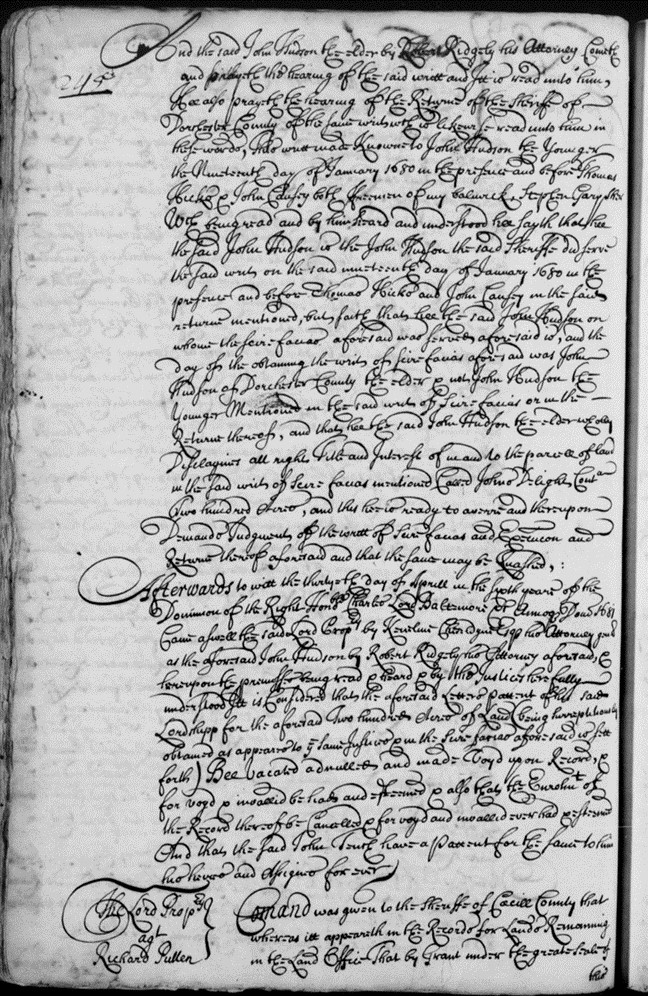
(January 1680) “And the said John Hudson the elder by Robert Ridgely his Attorney Cometh and prayeth the hearing of the said writt and Itt is read unto him Hee also prayeth the hearing of the Returne of the Sheriffe of Dorchester County of the same writ w.ch is likewise read unto him in these words This writt made Knowne to John Hudson the Younger the Nineteenth day of January 1680 in the presence and before Thomas Hicks & John Causey both Freemen of my baliwick Stephen Gary Sheriffe being read and by him heard and understood hee sayth that hee the said John Hudson is the John Hudson the said Sheriffe did serve the said writ on the said nineteenth day of January 1680 in the presence and before Thomas Hicks and John Causey… .” (End Note 15)
Figure 3 is an image of the original document the body of which provides a glimpse into the daily life of Dorchester County, Colonial Maryland in the 17th Century.
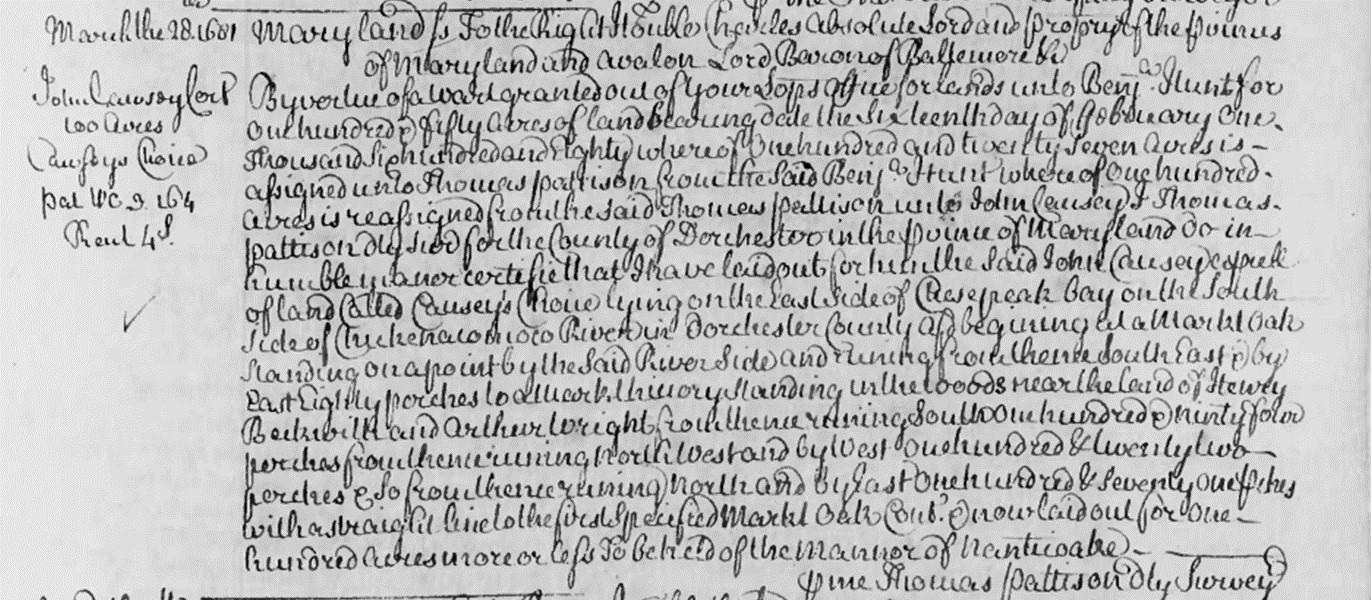
John Causey-II also received two land grants during this three year period. The first grant is shown as John Causey 28 March 1681, 100 acres called “Causeys Choice”. The following is an extract from that grant followed by the actual image:
“Mach 28, 1681 Maryland: To the Right Honorable Charles absolute Lord and Proprietor of the province of Maryland and Avalon Baron of Baltimore etc. By virtue of War’t out of … Stuart for lands unto Benj Stuart for one hundred acres of land bearing date the 16th day of February one thousand six hundred eighty whereof one hundred and twenty-seven acres is assigned unto Thomas Pattison from the Benjamin Stuart whereof one hundred and twenty acres is reassigned from the said Thomas Pattison unto John Causey, Thomas Pattison af’said for the county of Dorchester in the province of Maryland do in humble manner certifie that I have laid out for him the said John Causey parcell of Land Called Causey’s Choice lying on the East side of Chesapeake Bay on the south side of Tuckehaimococ River (Chicamacomico) Dorchester County afsd beginning at a markt oak side of Tuckahaimoco River (Chicamacomico) in Dorchester standing on a point by the said River side and running from thence South East by East eighty perches to a mark hicory standing in the woods near the land of Henry Beckwith and Arthur Wright, 100 acres more or less to the Manor of Nanticoke Thomas Pattison, Depty Surveyor.”
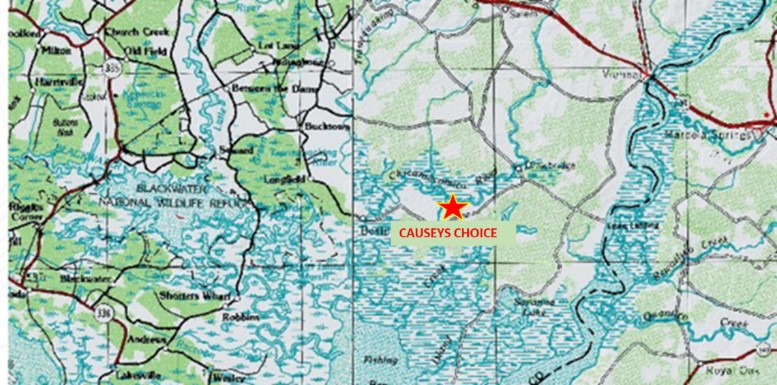
The star in Figure 5 marks the approximate location of John Causey-II’s first land grant.
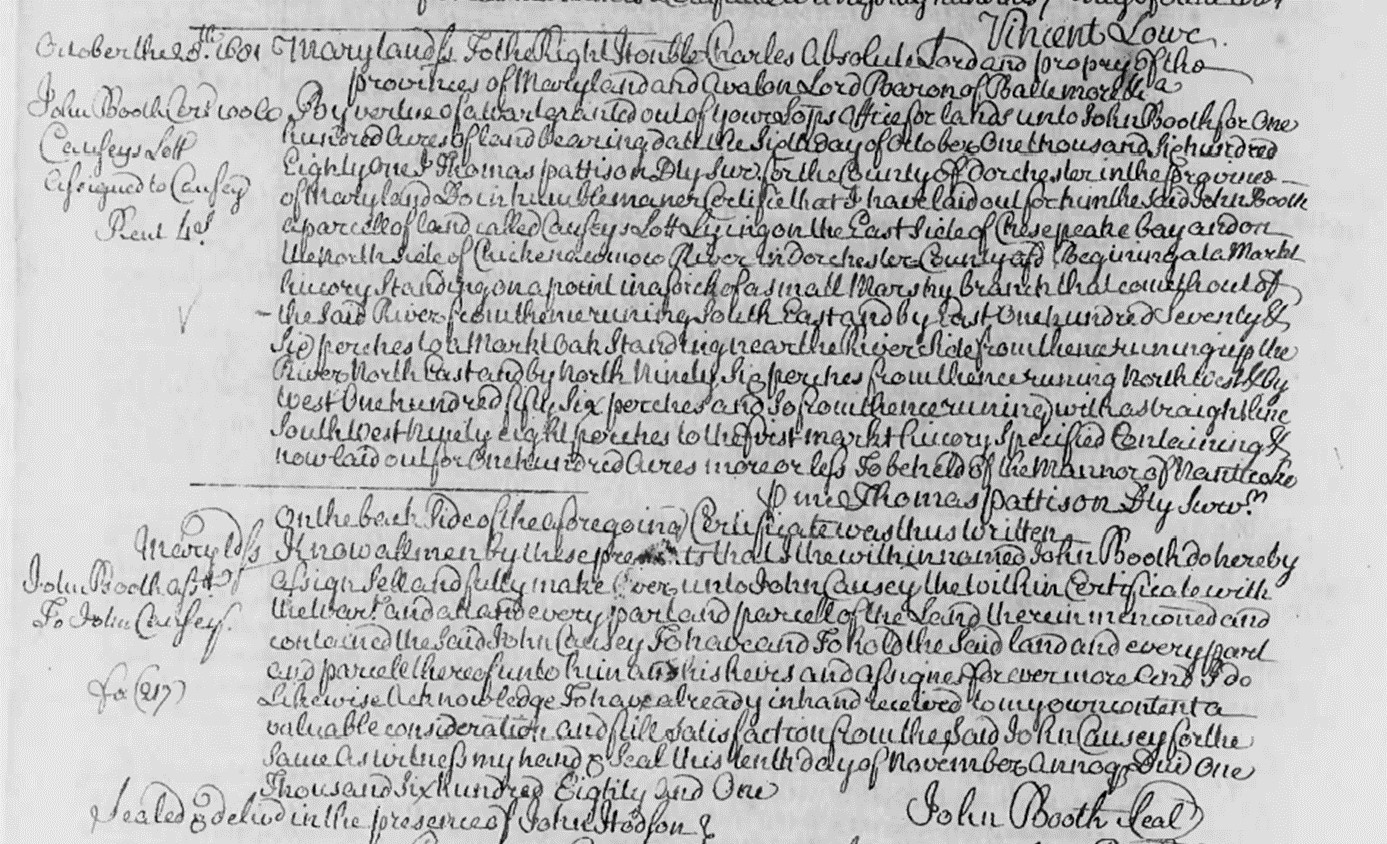
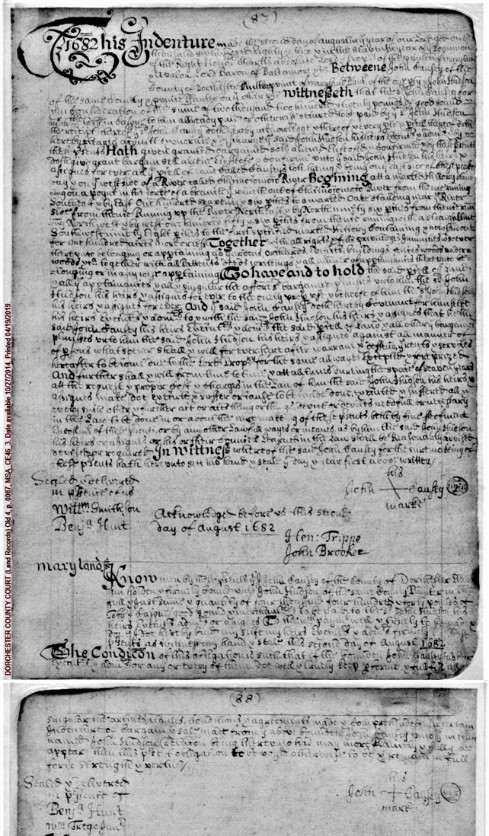
There are at least three recurring names in many of these documents: John Causey, John Booth, and John Hudson. Causeys Lott was purchased by John Causey-II on 10 November 1681 from John Booth, Figure 6. John Causey-II quickly sold Causeys Lott to his friend John Hudson on August 2, 1682, Figure 7.
The Causeys of Dorchester County, British Colonial Maryland were not the only Causeys in that region. There were many Cawsey, Carsey, Coursey, and Causey names in neighboring counties. These names are spelled differently not because they had different lineages necessarily but because they were spelled phonetically by different writers and transcribers. Herbert C. Fooks in his book Fooks Family, (End Note 22) on page 287 provides this analysis:
“The following Causey data may be supplemented by old records such as family records in bibles to show the relationship, if any, to Patrick Causey who in his will probated in Worcester Co., Md., c. 1753 stated that he was formerly of Kent on Delaware (formerly part of Dorchester County, Colonial Maryland). The Causey coat of Arms has been included for general information. So far as is known by the writer it has not been shown to appertain to the Patrick Causey line of the family. A study of the records in Dorchester County shows that the Causeys settled there at a very early date. They acquired lands in various parts of the county, which then included what is now a portion of Caroline County, so the land was a few miles from Kent County, Maryland, and near Kent County, Delaware, for its eastern boundary. The names of some of the early Causey settlers in Dorchester, (Caroline), John, William and Philip, are the same as those in the Will of Patrick Causey I. Some of these early records are set forth hereinafter for what they may be worth. This information may lead to other information that will show conclusively the ancestor of Patrick Causey I.” (End Note: 22)
It is reasonable to believe that a number of sons and daughters might have been born to William, Thomas and John Causey as well as Nathaniel and Thomasine Causey of Jamestown Colony, Virginia. Some of these third generation Causeys remained in Virginia, others probably migrated north to Maryland’s first settlement at after Charles Calvert, Lord Baltimore, opened the land for settlement in 1634.
NOTE: Only John Causey-II has, so far, been found in available records of Dorchester County, Colonial Maryland during the second half of the 17th Century, 1674 to 1700. There is, however, a William Coursey, (Causey) who was a land surveyor in Dorchester County during the mid-17th century. The following is a Dorchester County deed extract from 1778:
1 Old 167 December 11, 1678 (Daniell Clark ) (Henry Tripp ) Prest: (Robt. Winsmore ) of ye Quo. ( ) Justices (Wm.Stevens ) (Thos. Skinner ) Testimony of John Edmondson re bounds of land of John Horn on Horn’s Point marked by William Coursey (Causey), Surveyor, and John Edmondson. witnesses: Robert winsmore, ThomasTaylor. (End Note 25)(Volume I, pg26)
Note by the author of this essay: William Coursey was Junior Deputy Surveyor
in the Survrs. office in Talbert County. (End Note 26)
Therefore, all the events listed below can logically be assumed to be the same John Causey.
- Proceedings and Acts of the General Assembly, October 1678-November 1683, “An Act for payment and assessing the Publick Charges of this Province, The Act indicates the payment to the Militiamen was for “the late Expedicon against the Nanticoke Indians,” of 1674-1678s… To Charles Hutchyson To John Hudson To John Curtice & to John Causey & every & each of them six hundred pounds of Tobacco.
- 19 January 1680 John Causey, Freeman of Dorchester County, Colonial Maryland called as a witness in a local hearing.
- “March 28, 1681 Maryland: In the rent rolls a tract of “100 acres, Causey’s Choice, surveyed 28th March 1681 for John Causey on So. Side of Chicacomoco (Chicamacomico) at an oak upon a point by the River side in possion of James Hudson.” Rent Rolls of Dorchester County.
- 4 Old 87 August 2, 1682 John Causey of Dorchester County, planter to John Hudson of the same County, planter: “Causeys Lott” on the west side of Chicamocomico River, containing 100 acres more or less. Witnesses: William Smithson, Benj. Hunt. Acknowledged August 2, 1682. Henry Trippe, John Brooke. (Vol 2 pg 71)
- John Cawsey Witness, March 5, 1715: John Tench of Dorchester County to James Hayes of the same county: …part of “Tenches Regulation” witnesses: Jos. Cawsey, Jno. Cawsey.
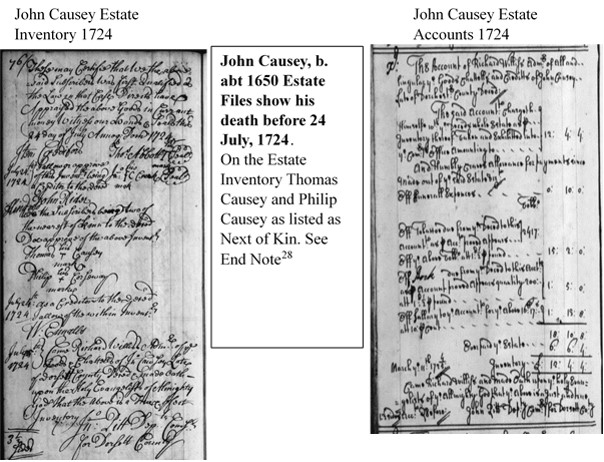
- John Causey Deceased 1724. In 1724 An accounting was made by Richard Willis of all and singular the goods and chattels and credits of John Causey late of Dorchester County, deed. Liber 6, Folio 303.
This John Causey, (John Causey-II), would have been of age to serve in the militia by 1674, (Each colony had their own militia laws but most agreed that the militia consisted of all able bodied white males, ages 18-45.) The mid age of service would be about 25 to 30 years of age. The late “Expedicon against the Nanticoke Indians” began in 1674. This would confirm that John Causey-II would have been born about 1650. This then would suggest that John Causey-II was around 75 at his decease in 1724.
In the next chapter we will examine the second and third generations of the Causey family of Dorchester County, British Colonial Maryland from the 1680s through the 1700s.
Leave a Reply